


Islamabad – More than 500 acres of government land in Toba Tek Singh were allegedly handed over to private individuals during the tenure of a former Deputy Commissioner, a Pakistan Administrative Service (PAS) officer, through the grant of proprietary rights. The Punjab Board of Revenue examined the matter and identified multiple violations of government policies in the allotment files. The issue was brought to the Punjab Assembly through Starred Assembly Question No. 825, raised by MPA Amjad Ali Javed of PP-121. Following the question, the Board of Revenue sought records from the District Collector,
Toba Tek Singh, regarding the grant of proprietary rights during 2023 and 2024. In a letter dated August 15, 2024, bearing reference No. 1175-2024/1653-CL-I, the Colonies Department of the Board of Revenue informed the Commissioner of Faisalabad Division that its examination of the available record had revealed numerous irregularities. The letter stated that 51 district allotment files forwarded by the Additional Deputy Commissioner (Revenue), Toba Tek Singh, had been examined on a random basis and that several violations of the prescribed policies had been found.
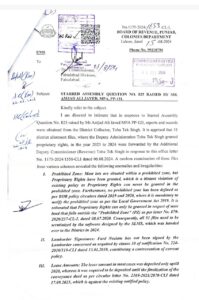
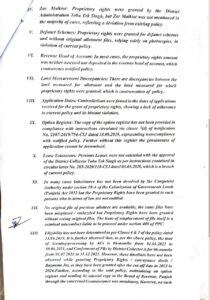
 The Board reported that proprietary rights had been granted over land situated in prohibited zones, contrary to the applicable policy. It also noted that the prohibited zones had not been properly notified in accordance with the relevant requirements. The Board directed that all 51 files be checked through the software developed by the State Land Management System (SLMS), which had been handed over to the district in 2024. The letter listed several other violations. Fard Neelam documents did not bear the signatures of the concerned Lambardars, as required under the relevant notification.
In most cases, lease payments had been deposited only up to 2020, despite instructions requiring payment until the conveyance deed was finalised. Zar Malkiat was also missing from most cases. The Board further reported that proprietary rights had been granted under defunct schemes and, in some cases, without original allotment files. Photocopies had been used in place of original records. Other irregularities included discrepancies in land measurements, conflicting dates on applications, failure to assess or deposit proprietary-rights amounts under the relevant government revenue head, and the absence of the mandatory option register. The official letter also pointed out that proprietary rights had been granted in certain cases without the proper devolution of inheritance by the competent authority under Section 19-A of the Colonization of Government Lands (Punjab) Act, 1912. As a result, people whose legal entitlement had not been properly established were granted ownership rights. The Board also noted that original files relating to previous allottees were missing or unavailable, yet proprietary rights had been granted without examining the original records. The letter stated that the disappearance of government files could amount to criminal misconduct and referred to possible proceedings under Section 409 of the Pakistan Penal Code.
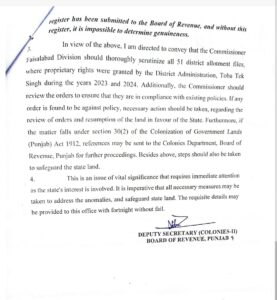
The eligibility of beneficiaries was also found to be questionable under Clauses 4 and 5 of the policy dated September 13, 2019. According to the Board, the policy prescribed specific periods for scrutiny by Assistant Commissioners and the grant of proprietary rights by District Collectors. However, the relevant rights and conveyance deeds were issued in 2023 and 2024, long after the prescribed deadlines. Following these findings, Deputy Secretary (Colonies-II), Board of Revenue, Punjab, directed the Commissioner of Faisalabad Division to examine all 51 allotment files in detail and review the orders through which the district administration of Toba Tek Singh had granted proprietary rights during 2023 and 2024. The Commissioner was instructed to take action against orders found to be contrary to government policy, including reviewing the grants and taking steps to resume the land in favour of the State. Cases falling under Section 30(2) of the Colonization of Government Lands (Punjab) Act, 1912, were to be referred to the Colonies Department for further proceedings. The Board also directed the Commissioner to protect government land and submit the required details within 15 days. According to information received in connection with the case, more than 500 acres of government land were allegedly transferred to private individuals, with claims that heavy bribes were paid to secure proprietary rights. The former Deputy Commissioner has been accused of granting ownership rights in government land in return for illegal financial benefits. The matter was subsequently referred to Commissioner Faisalabad Maryam Khan for further scrutiny. However, according to the allegations received, the file was not pursued and the inquiry was left pending. Maryam Khan has been accused of failing to act against the former Deputy Commissioner because of their alleged close personal relationship. The Board of Revenue had specifically directed the Commissioner to scrutinise the 51 files, review the orders and take action wherever violations were found. It had also called for the recovery of government land where the grants were found to be contrary to policy.
The alleged failure to pursue the matter has left the action taken on these directions unclear. The case concerns the grant of proprietary rights over government land, the disappearance of original allotment records, violations of prescribed procedures and the alleged transfer of a substantial area of public land to private individuals. The Board’s letter documents numerous irregularities and directs the divisional administration to examine the files and take appropriate action. The provincial government and the Board of Revenue are expected to explain what action was taken following the August 15, 2024 letter, whether the 51 files were examined as directed, whether any official was held responsible and whether steps were taken to recover government land granted in violation of the applicable policy.

