

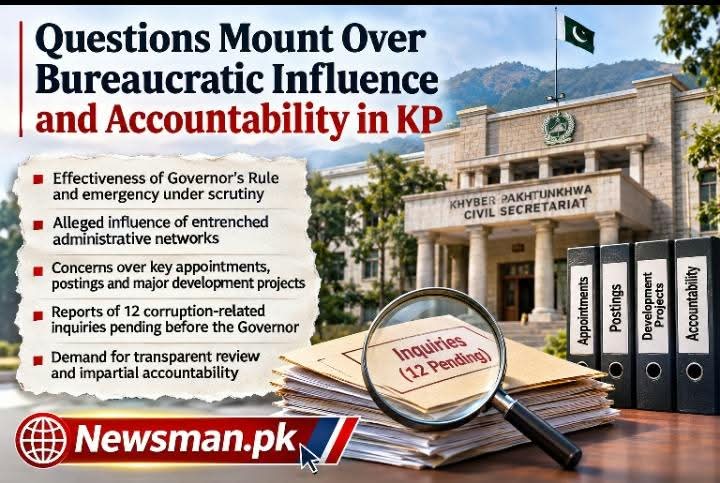
PESHAWAR – Serious questions are increasingly being raised over the effectiveness of the ongoing emergency and Governor’s Rule in Khyber Pakhtunkhwa, particularly regarding the bureaucratic structure, accountability process and alleged influence of entrenched administrative networks over key government affairs.
Reports appearing in different sections of the media, coupled with concerns expressed by people from various segments of society, suggest that despite the change in the political and administrative environment, certain elements associated with the previous system may still be exercising influence over important appointments, postings and decision-making processes.
According to these reports, some bureaucrats who allegedly benefited from successive governments continue to occupy important positions or remain influential within the administrative structure.Allegations have also surfaced regarding the alleged accumulation of substantial assets, including properties and bank balances in Pakistan and abroad, by certain serving or former bureaucrats. Such allegations, however, require independent verification and investigation by the competent authorities before any definitive conclusion can be reached.
Particular concern has been expressed over strategically important positions in the Planning and Development Department, Monitoring and Evaluation, and projects being implemented with financing from international development institutions.It has been alleged that certain project directors and officials considered close to influential bureaucratic circles continue to hold key positions involving public funds, including projects reportedly financed through loans exceeding Rs600 billion from the Asian Development Bank and the World Bank.
The reports further allege that some bureaucrats who were sidelined or moved from influential positions, along with personnel allegedly recommended by them, continue to maintain links within the administrative structure and obtain information about government decisions and developments.
There are also allegations that certain sections of the media are being used to influence public opinion or protect particular interests.Some journalists have reportedly benefited in the past from political and bureaucratic figures through alleged appointments, vehicles, contracts or other personal advantages.These allegations should likewise be independently examined, particularly where they concern the use of public resources or official authority.
Of particular concern are reports that 12 corruption related inquiries are currently pending before the Governor. The question being raised is why these inquiries have allegedly not moved forward and whether any individuals or groups are attempting to delay, influence or obstruct the process.
The public has a legitimate right to know the status of these inquiries, the nature of the allegations involved, the departments concerned and the reasons for any delay. If the allegations are found baseless, the officials concerned should be cleared through a transparent process.If evidence exists, the law should take its course without discrimination.
Questions have also been raised in media reports about the alleged continuation of networks associated with senior bureaucrats, including Shahab Ali Shah and Abid Majeed.Whether such networks continue to exercise influence is a matter that can only be established through an impartial administrative and investigative process.
Similarly, reports have questioned the continued presence of certain officials in important positions despite allegations or inquiries relating to their previous assignments.One case highlighted in the reports concerns a former Director General Sports against whom an inquiry involving approximately Rs1 billion is reportedly pending, while the officer is said to be holding an important position in Peshawar.
The issue therefore goes beyond the question of an individual officer’s guilt or innocence.The larger question is whether officials facing serious financial or administrative inquiries should continue to occupy sensitive positions while those inquiries remain unresolved.
Media reports have also raised questions concerning the continued presence of officials identified as Adil Safi, Usman Zaman, Gabriel and Abid Majeed in or around influential administrative positions.The exact status of these officials, any inquiries pending against them and the legal or administrative basis for their postings should be clarified by the relevant authorities.
The central concern emerging from these developments is whether the Governor’s Rule and emergency arrangement have resulted in a genuine change in the administrative system or whether influential elements of the previous structure continue to retain their positions, access and networks.
The credibility of the present arrangement will depend substantially on how it responds to these questions.
There is now a growing demand for an impartial review of sensitive appointments, pending corruption inquiries, major development projects and the role of individuals allegedly exercising influence behind the scenes.
The provincial administration and the Governor’s office can address these concerns most effectively by making the status of pending inquiries transparent, ensuring that sensitive positions are occupied strictly on merit and allowing competent accountability institutions to investigate allegations independently.
The people of Khyber Pakhtunkhwa do not merely need a change of faces; they need evidence that the system itself is being made more transparent, accountable and resistant to influence.
If allegations of entrenched bureaucratic networks, protection of officers facing inquiries and manipulation of administrative decisions are substantiated, failure to act would inevitably raise further questions about the purpose and effectiveness of the present emergency arrangement.

