

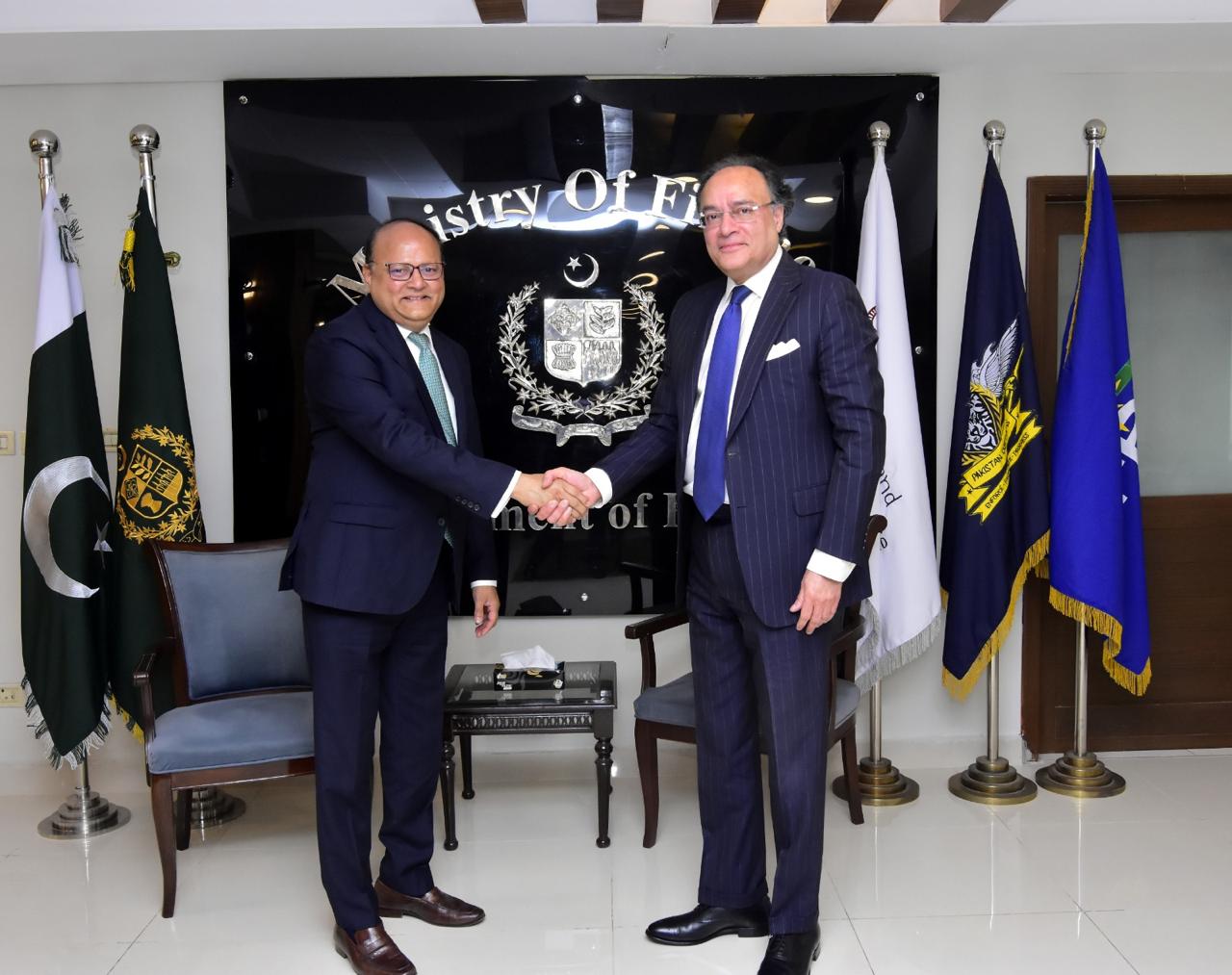
Islamabad — September 10, 2026: Federal Minister for Finance and Revenue, Senator Muhammad Aurangzeb, held a meeting with Mr. Srini Nagarajan, Managing Director and Head of Asia, British International Investment (BII), to discuss opportunities for expanding BII’s investment footprint in Pakistan and mobilizing greater private capital across priority sectors a Finance Division handout said.
It noted Mr. Nagarajan was accompanied by Mr. Imtiaz Saithna, Head Pakistan; Ms. Reema Gani, Manager Pakistan; Mr. Sam Waldock, Development Director, FCDO; and Mr. Zaigham Iqbal, Investment Manager.
“The discussions focused on BII’s investment plans for Pakistan, private capital mobilization, infrastructure and climate finance, private equity, SME financing and emerging investment opportunities arising from Pakistan’s ongoing economic and structural reforms” the handout said.
It added Mr. Nagarajan briefed the Finance Minister on BII’s 2026–31 investment strategy, under which the institution plans to invest at least US$2 billion across Asia and Africa, with a significant focus on South Asia and frontier markets. He identified Pakistan as an important investment destination and expressed BII’s interest in significantly expanding its investment footprint in the country over the coming years.
He also outlined BII’s focus on mobilizing private capital alongside its own investments and leveraging its experience across infrastructure, climate finance, financial services, technology and private markets to help develop investable markets and crowd in additional capital.
The Finance Minister welcomed BII’s continued commitment and interest in scaling up investment in Pakistan. He highlighted the significant improvement in macroeconomic stability and investor confidence, alongside the Government’s focus on structural reforms, privatization and a transition towards private-sector-led growth.
Senator Muhammad Aurangzeb noted that Pakistan’s successful US$3 billion international bond issuance, continued progress on privatization and successive improvements in sovereign credit ratings reflected strengthening confidence in Pakistan’s economic direction and its re-engagement with international investors and capital markets.
According to the handout , the BII delegation highlighted the potential of private equity, fund-of-funds structures and private credit to deepen financial intermediation and strengthen Pakistan’s domestic investment ecosystem. Mr. Nagarajan welcomed ongoing capital-market reforms and efforts to improve the investment and exit environment, noting that greater certainty and confidence could help attract larger pools of long-term private capital.
The delegation also highlighted BII’s interest in climate-related investment, renewable energy and infrastructure, including power transmission, and expressed readiness to bring international experience and expertise to the development of viable financing structures and investable opportunities.
The Finance Minister briefed the delegation on ongoing reforms across taxation, energy, tariff policy, capital markets and digitalization. He highlighted the Government’s five-year tariff rationalization programme aimed at creating a more competitive and efficient industrial environment, with policy support increasingly linked to performance and time-bound measures.
The discussion also covered opportunities to develop new capital-market instruments for infrastructure financing and explore innovative approaches, including the potential tokenization of suitable existing real estate assets, to broaden investment channels and mobilize new pools of capital.
Senator Muhammad Aurangzeb also briefed the delegation on the Committee constituted to develop a National Private Equity Policy Framework, aimed at strengthening Pakistan’s private equity ecosystem, building domestic fund-management capacity and mobilizing long-term domestic and international capital.
He further highlighted the Government’s broader Access to Finance agenda, including efforts to expand financing for SMEs, agriculture and other underserved segments through private credit, risk-sharing mechanisms, digital platforms and stronger financial infrastructure. The Finance Minister emphasized that deeper access to finance and greater private-capital mobilization were essential to translating macroeconomic stability into investment, productive capacity, exports and sustainable economic growth.
The two sides discussed opportunities for closer collaboration in climate finance and infrastructure, including the role development finance institutions can play in de-risking projects, mobilizing private investors and developing practical financing solutions. The Finance Minister welcomed BII’s offer to contribute its international experience to relevant Government initiatives, studies and policy forums, emphasizing the importance of bringing development finance institutions and private investors together around specific and investable opportunities.
Mr. Nagarajan appreciated the improvement in Pakistan’s macroeconomic environment and expressed confidence in the country’s economic prospects. He reaffirmed BII’s commitment to Pakistan and its interest in expanding investment while supporting market development and mobilizing additional private capital for sustainable growth.
The Finance Minister welcomed BII’s continued engagement and encouraged the timely consideration of investment proposals and movement towards concrete transactions. The two sides agreed to maintain close engagement and explore actionable opportunities for investment, knowledge sharing and private capital mobilization across Pakistan’s priority sectors, it concluded.

