The timing of an unusual confrontation raises questions about bar politics, judicial
influence and the wider political contest surrounding PTI’s march on Islamabad.
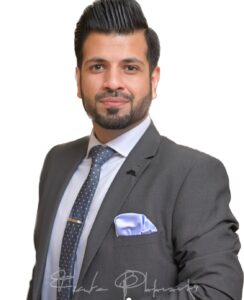
By Barrister Ch Ahsan Hussain Ali
At first sight, the increasingly public confrontation between Capt (retd) Muhammad Safdar and
senior lawyer Ahsan Bhoon appears to be another particularly heated episode of Pakistani bar
politics.
Perhaps that is all it is.
But politics is often as much about timing, institutional positioning and unintended consequences
as it is about declared intentions. And the timing of this dispute – immediately before the
Supreme Court Bar Association elections and alongside PTI’s planned march towards Islamabad –
makes it worth examining beyond the personalities involved.
It is important, however, to distinguish throughout between what is known, what has been
alleged, and what remains political speculation.
What we actually know
The Supreme Court Bar Association election is scheduled for 29 October 2026. The
Independent Group, commonly associated with the late Asma Jahangir and currently led by
Ahsan Bhoon, has nominated Syed Amjad Ali Shah for president. The Professional Group
associated with Hamid Khan has fielded Sardar Aman Khan. Capt Safdar has meanwhile
announced his own Quaid-i-Azam Muhammad Ali Jinnah Group and has become an unusually
visible participant in the lawyers’ electoral contest.
The political anomaly is immediately apparent.
The PML-N Lawyers Forum has reportedly announced support for the Independent
Group, yet Capt Safdar – himself a senior political figure associated with the PML-N and husband
of Punjab Chief Minister Maryam Nawaz – has publicly challenged the credentials of the
Independent Group’s presidential candidate and subsequently questioned the educational and
professional credentials of Ahsan Bhoon himself.
Safdar has reportedly taken the matter beyond political speeches by submitting a complaint to
the Secretary of the Judicial Commission of Pakistan (JCP) seeking scrutiny of Bhoon’s
educational certificate, enrolment and professional credentials. Bhoon is himself presently a
member of the JCP.
These are allegations and requests for verification. They should not be confused with established
findings concerning anyone’s qualifications.
The controversy has subsequently become even more personal. Safdar has also approached the
NCCIA concerning allegedly defamatory online material published against him after he raised the
degree controversy. Again, those competing allegations are matters for the relevant forums
rather than conclusions that ought to be reached through newspaper columns.
So far, these are the facts of the political landscape. The interesting questions begin after them.
Is this really only about an SCBA election?
The simplest explanation should always remain available.
Bar elections in Pakistan are intensely competitive. Personal relationships, regional affiliations
and old professional disagreements can matter almost as much as national politics.
Amjad Shah has publicly characterised Safdar’s campaign against him as originating in a
previous personal disagreement and has disputed Safdar’s allegations. That explanation cannot
simply be discarded merely because more elaborate political theories are attractive.
But there are several reasons why I find it difficult to look at the present controversy purely as an
interpersonal dispute.
The first is the institutional significance of the people involved. The second is Safdar’s apparent
departure from the position adopted by the PML-N Lawyers Forum. The third is the
extraordinary political environment in which the dispute has erupted.
The PTI long-march coincidence
PTI had originally announced that its march towards Islamabad would commence on 27
September. The party subsequently postponed its departure from Peshawar until 4 October.
The march is intended, among other stated objectives, to press for the release of Imran Khan.
Security preparations have been extensive, while PTI workers and activists have faced preventive
action ahead of the planned mobilisation. Reporting has also referred specifically to monitoring
involving the Insaf Lawyers Forum in Rawalpindi Division.
That matters because organised lawyers have historically possessed an ability to transform a
political dispute into an institutional and street-level movement.
This gives rise to the first theory circulating around the present controversy:
Is somebody attempting to disturb the existing alignment of the organised bar
before a potentially significant confrontation in Islamabad?
There is presently no publicly available evidence demonstrating that Capt Safdar is acting
for PTI, coordinating with PTI or deliberately facilitating its march. Any assertion to that
effect would go considerably beyond the known facts.
Nevertheless, political consequences do not always require political coordination.
If an influential government-aligned lawyers’ bloc becomes divided or preoccupied with an
internal legitimacy contest, other organised groups within the bar may benefit from that
fragmentation. That is a possible political consequence, irrespective of whether it was anybody’s
intention.
The more interesting possibility: an internal power struggle
To me, the more intriguing explanation is not necessarily a PTI conspiracy at all. It could instead
reflect tensions within the broader political and legal establishment supporting the
present governmental arrangement
Ahsan Bhoon’s influence extends beyond SCBA electoral politics. He serves on the Judicial
Commission of Pakistan, an institution directly involved in appointments to the superior judiciary.
Therefore, when Safdar asks the JCP itself to scrutinise the credentials of one of its members, the
issue acquires an institutional dimension substantially greater than an argument over votes in a
bar election.
Question the credentials; question professional legitimacy; question representative
legitimacy; potentially weaken institutional influence.
That does not prove that weakening Bhoon’s position within the JCP is Safdar’s objective. There
is no public evidence establishing such a design. But it is a foreseeable political consequence of
the course Safdar has adopted.
And that distinction – between intention and effect – may ultimately be the key to
understanding this entire controversy.
The curious PML-N contradiction
Another question deserves attention. Why would an important figure closely associated with the
PML-N publicly attack a lawyers’ group which the PML-N Lawyers Forum itself reportedly
supports?
Several explanations are possible. Safdar may simply be acting independently. The dispute may
be personal. There may be genuine disagreement within the party’s wider legal constituency. Or
the apparent contradiction may provide political flexibility.
One interpretation – and I emphasise that this is interpretation rather than evidence of
coordination – is that Safdar’s position creates a form of political optionality.
The formal lawyers’ organisation can maintain its relationship with the Independent Group while
another prominent political figure simultaneously establishes distance from it. If relations remain
useful, the institutional alliance survives. If circumstances change, an alternative political
position has already been established.
Such arrangements are hardly unique to Pakistani politics, but there is presently no evidence
from which one could responsibly conclude that this has been deliberately orchestrated by the
PML-N leadership.
Indeed, reporting from within Bhoon’s camp has suggested the opposite – that Safdar’s campaign
does not represent the Sharif family’s position. That too remains the account of interested
political participants rather than proof of what discussions may or may not have taken place
privately.
Could PTI benefit without being involved?
This, in my view, is where much of the conspiracy discussion becomes confused.
There is a substantial difference between saying “PTI is behind Safdar” and saying
“PTI-aligned or government-opposed forces could benefit from what Safdar is doing.”
The first proposition requires evidence which has not emerged publicly. The second is a political
hypothesis
The Independent Group and the Professional Group represent competing centres of power within
organised bar politics. The Professional Group has historically included lawyers associated with
or sympathetic to PTI, although neither professional group should be reduced entirely to one
political party.
If Safdar’s campaign damages the Independent Group politically before the SCBA election, its
opponents may benefit. That does not establish collusion. Sometimes one’s opponent’s opponent
simply benefits from a conflict he did not create.
Why the JCP angle may ultimately matter more than PTI
The temptation will naturally be to interpret everything through the PTI-government
confrontation because the long march dominates current political discussion. I suspect that may
cause observers to overlook the more important institutional question.
The JCP influences the composition of Pakistan’s superior judiciary. Superior-court appointments
influence the development of constitutional law. And constitutional litigation sits at the centre of
many of Pakistan’s present political disputes.
Therefore, a controversy affecting the standing of a JCP member potentially matters well beyond
one SCBA election.
That is why I would watch the language Safdar uses from this point onwards.
If the campaign remains principally about Amjad Shah, professional qualifications and the SCBA
election, the simpler explanation of bar politics becomes stronger. If it increasingly moves
towards the JCP, judicial appointments, constitutional restructuring or the institutional
role of particular lawyers, the dispute begins to look considerably larger.
The long march may be a test, not the explanation
PTI’s postponement of the march from September 27 to October 4 has itself generated
speculation. Dawn reported differing explanations, including logistical difficulties and accounts
from unnamed insiders concerning pressure and backchannel contacts. Those accounts should be
treated as attributed reporting rather than established fact.
For the Safdar-Bhoon controversy, October may therefore provide useful evidence. I would watch
three developments:
First, does Safdar’s campaign continue with the same intensity after PTI’s Islamabad
mobilisation has passed? Second, does the Professional Group, PTI or the Insaf Lawyers Forum
formally adopt the allegations raised by Safdar, or maintain distance from them? Third, does the
dispute remain confined to the SCBA election, or migrate towards the Judicial Commission and
wider questions concerning judicial appointments and constitutional power?
Those developments would allow us to distinguish between three very different possibilities: a
particularly bitter bar-election dispute; an internal struggle for influence within the political-legal
establishment; or a conflict whose consequences intersect with the larger government-PTI
confrontation.
My reading
For the moment, I would resist the dramatic conclusion that “Safdar is doing this for PTI.”
There is simply insufficient public evidence to responsibly state that
What I do find significant is the structure of the conflict.
A prominent political figure associated with the ruling party is challenging a lawyers’ faction
reportedly supported by his own party’s Lawyers Forum. He is questioning not merely an
electoral candidate but one of the most influential figures within that group. The challenge has
reached the Judicial Commission. All of this is occurring while the government faces a major
opposition mobilisation in which lawyers themselves could become politically significant.
That combination is unusual enough to deserve scrutiny.
The eventual explanation may prove mundane: personality, regional rivalry and bar-election
arithmetic. But another possibility deserves consideration – not as an allegation, but as a political
hypothesis.
Perhaps the real contest is not about who becomes President of the Supreme Court
Bar Association at all. Perhaps it is about who speaks for the organised legal
community, who retains influence within the institutions surrounding the
judiciary, and where those lawyers stand when Pakistan’s next constitutional
confrontation arrives.
For now, that remains a question. And in politics, sometimes the questions raised by the timing of
events are more revealing than the accusations being shouted in public.