


Alishba Malik
“All across the world, in every kind of environment and region known to man, increasingly dangerous weather patterns and devastating storms are abruptly putting an end to the long-running debate over whether or not climate change is real. Not only is it real, it’s here, and its effects are giving rise to a frighteningly new global phenomenon: the man-made natural disaster”
Barack Obama, April. 3, 2006
Although, Pakistan contributes only to 0.8% (less than 1%) of global green house gas but it ranks 5th most vulnerable country in the world. The devastating floods of 2022 and the recent floods in Pakistan is a clear example of this vulnerability. The World Bank / Government Post-Disaster Needs Assessment (PDNA) and OCHA estimated ~33 million people affected, thousands deaths (official reported~ 1,700 deaths) and economic damages/losses in the tens of billions USD (PDNA/World Bank cited figures around USD 30–40 billion and a recovery need in the order of USD ~16 billion).
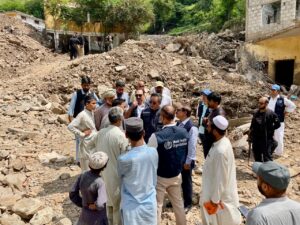
Pakistan continues to see intense localized cloudburst and flashfloods during monsoon seasons. As we witnessed the recent floods and cloud bursts in most of the areas of Pakistan including, KPK, GB, AJK and now in Punjab.
Over 800 people have died, with 965+ injured and 295+ missing as of August 2025. The most heavy losses have seen in KP with 469 deaths and while Punjab has reported 169 fatalities. More than 1.2 million people affected with hundreds of thousands displaced. The Primary causes of these floods are:The intense monsoon rainfall, with floods amplified by cloudbursts and glaciallake outbursts notably in Ghizer (GB).
Climate change is increasing rainfall intensity and glacier melt, driving these extreme weather events.
However, cross border water release from India’s dams, especially effecting Punjab’s rivers (Ravi, Sutlej and Chenab) have further inflamed flooding.
Along with that, urban mismanagement is again another big problem as poor drainage systems in cities, deforestations and settlements near water bodies have heightened flood vulnerability.
But these conditions are not sudden as National Disaster Management Authority (NDMA), Pakistan Meteorological Department (PMD), and international partners (UNDP, World Bank, have repeatedly issued reports highlighting Pakistan’s high flood risk due to:
Limited water storage (only ~30 days carryover capacity).
Silted dams (Tarbela, Mangla losing capacity).
Climate change increasing intensity of monsoon and glacier melt.
The Germanwatch Climate Risk Index has consistently ranked Pakistan among the top 10 most climate-vulnerable countries since 2000.

After 2010 and 2022 floods, the World Bank, UN, and Pakistan’s own commissions recommended: Building new reservoirs (Diamer-Bhasha, Mohmand).
Investing in early warning systems and flood zoning .Relocating communities away from high-risk riverbanks.
So why having all these alerts and recommendations Pakistan’s government do not take steps to save it people? As hundreds of thousands of people displaced every year due to floods, most of the families lost their loved ones their life time properties. Instead of spending millions on reconstruction and aftermaths why not precautionary measures are taken, why government do not make dams as it is one of the most important need of Pakistan, what the purpose of donations and aids when you not even think of your people first, these aids do not get back their loved ones and their properties. Instead of denying aid, proactive measures should be taken to protect precious lives and people’s lifetime savings from being lost. The aid received from foreign countries for climate resilience should be utilized for the welfare of the people. Instead of spending millions on aid and donations, we should focus on building dams. If the authorities truly consider the public as their own, they should find permanent solutions rather than just making videos with flood victims and shirking their responsibilities. Although this is a natural issue, timely and proper action can help us gain control over it to a great extent. My appeal to the authorities is to kindly build dams, improve drainage systems, and make Pakistan truly climate-resilient. Providing temporary relief to flood victims won’t solve the problem; instead, we need to address the root causes of their suffering, which are often a result of our own policies. Let’s focus on finding permanent solutions to this devastating issue. Because precaution is better than cure.
The author can be reached at :

