

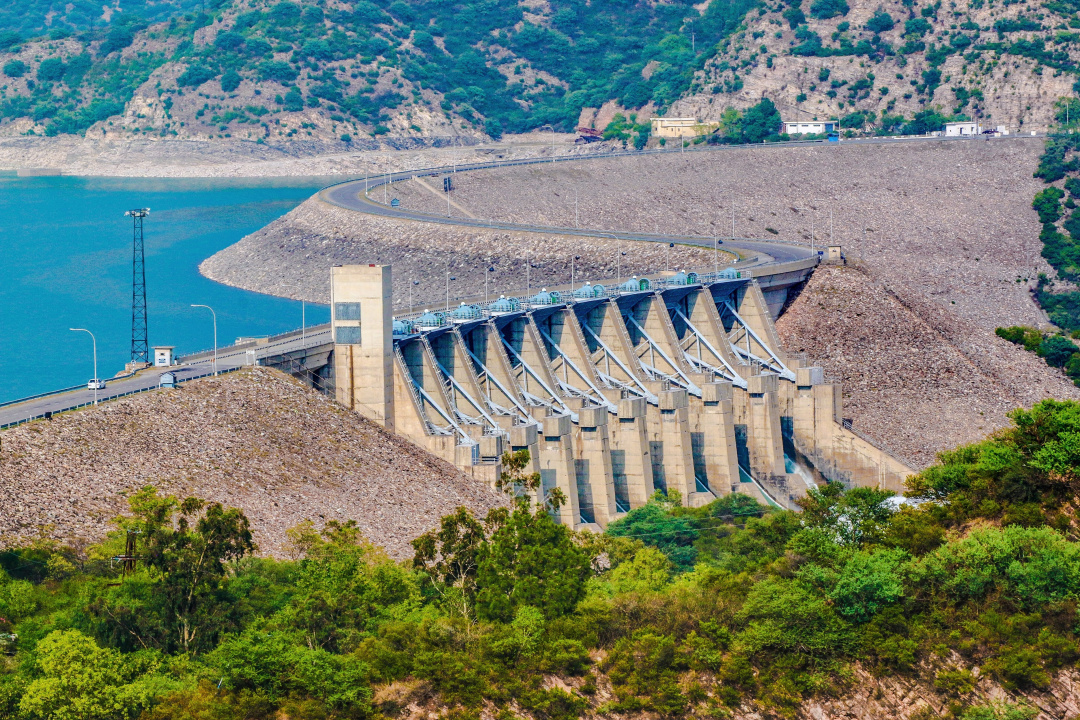
- ISLAMABAD: India has accelerated work on several major hydropower projects on the Chenab River, with a number of strategic schemes under construction and others at various stages of planning, even as Pakistan continues to voice concerns over the suspension of the Indus Waters
Treaty (IWT) and the absence of bilateral consultations on upstream developments.
Speaking to NEWSMAN, Uttam Sinha, an Indian trans-boundary water expert and author of the book “Trial By Water”:(Indus Basin and India-Pakistan Relations”
, said the Chenab has become the primary focus of India’s hydropower development on the western rivers. He said New Delhi is proceeding with the projects without consultations with Pakistan after placing the Indus Waters Treaty in abeyance following the Pahalgam attack.
According to Sinha, three major hydropower projects on the Chenab are already operational: Salal (690 MW), Baglihar I & II (900 MW), and Dulhasti (390 MW). Projects currently under construction included the Ratle Hydroelectric Project (850 MW), Kiru Hydroelectric Project (624 MW), and Kwar
Hydroelectric Project (540 MW).
He said the Sawalkote Hydroelectric Project (1,856 MW) is currently at the Detailed Project Report (DPR) and statutory clearance stage, while Kirthai-I (390 MW), Kirthai-II (930 MW), and Dulhasti Stage II (258–260 MW) are among the proposed projects planned for the Chenab basin.
Sinha said the four projects receiving the greatest attention after India placed the treaty inabeyance are Pakal Dul, Ratle, Kiru and Kwar, which together form a cascade of hydropower projects on the Chenab River and its tributaries. He said the Indian government has accelerated implementation of these strategically important projects.
Explaining the technical framework of the treaty, Sinha said the Indus Waters Treaty allows India to construct run-of-the-river hydropower projects on the western rivers while permitting only limited water storage under clearly defined provisions agreed upon by both India and Pakistan. He maintained that the treaty does not allow unlimited storage and that these provisions wereincorporated after detailed technical deliberations by engineers during the negotiation of the agreement.
Referring to India’s decision to suspend the treaty, Sinha said a number of security-related incidents had contributed to deteriorating bilateral relations, but the Pahalgam attack ultimately became the trigger for New Delhi’s policy decision.
“The treaty has technically been kept in abeyance. India linked this decision to Pakistan’s behaviour following the Pahalgam incident. Since then, India has decided to move ahead with its
projects without discussions with its Pakistani counterpart,” he said.
Sinha said that before the treaty was put in abeyance, Pakistani experts regularly visited Indian project sites, technical consultations were held and hydrological data was exchanged between
the two countries. However, those mechanisms have now come to a halt.
“Transparency has stopped, data sharing has stopped and discussions are no longer taking place,” he said, adding that the absence of dialogue had contributed to growing mistrust and misunderstandings.
When asked whether it was appropriate to unilaterally suspend a bilateral treaty governing shared water resources over a security-related incident, and whether continued technical engagement
with Pakistan would have been a better way to address Islamabad’s concerns if India believes the projects comply with the treaty, Sinha said issues affecting millions of people should not become
victims of politics.
“I believe these misunderstandings should be removed through dialogue. Projects of public importance should not become victims of politics. India and Pakistan should discuss these issues, remove misconceptions and continue implementing projects in accordance with the treaty,” he said.
Pakistan, however, has consistently expressed concern over India’s upstream hydropower. projects and the suspension of the treaty.Pakistan’s Indus Waters Commissioner, Syed Muhammad Meher Ali Shah, said he had written
four letters to his Indian counterpart since April last year regarding unusual fluctuations in the flow of the Chenab River but had yet to receive any response.
He warned that variations in the river’s flow were “not merely a technical issue but a strategic threat,” reflecting Islamabad’s concern that upstream interventions could affect downstream
water availability.India, meanwhile, has maintained its position. Union Minister for Jal Shakti C. R. Patil recently said
the Indus Waters Treaty remains in abeyance and that, following Prime Minister Narendra Modi’s decision, every possible effort is being made to ensure that “not a single drop of water” reaches
Pakistan. He added that Home Minister Amit Shah is personally overseeing implementation of the government’s policy.India suspended the Indus Waters Treaty in April 2025 after accusing Pakistan of involvement inthe Pahalgam attack. Pakistan rejected both the allegation and India’s unilateral suspension of the treaty and subsequently approached the Court of Arbitration in The Hague.
The Court of Arbitration later ruled that India could not unilaterally suspend the treaty. However,New Delhi rejected the ruling and reaffirmed that the agreement would remain in abeyance.With bilateral dialogue suspended, technical exchanges frozen and work on key hydropower
projects continuing across the Chenab basin, concerns over the future management of one of South Asia’s most strategically important shared rivers continue to grow. While India maintains
that its projects are fully compliant with the provisions of the Indus Waters Treaty, Pakistan insists that the absence of consultations and transparency has heightened uncertainty over water flows
and reinforced the need for dialogue under the treaty’s established framework.

