

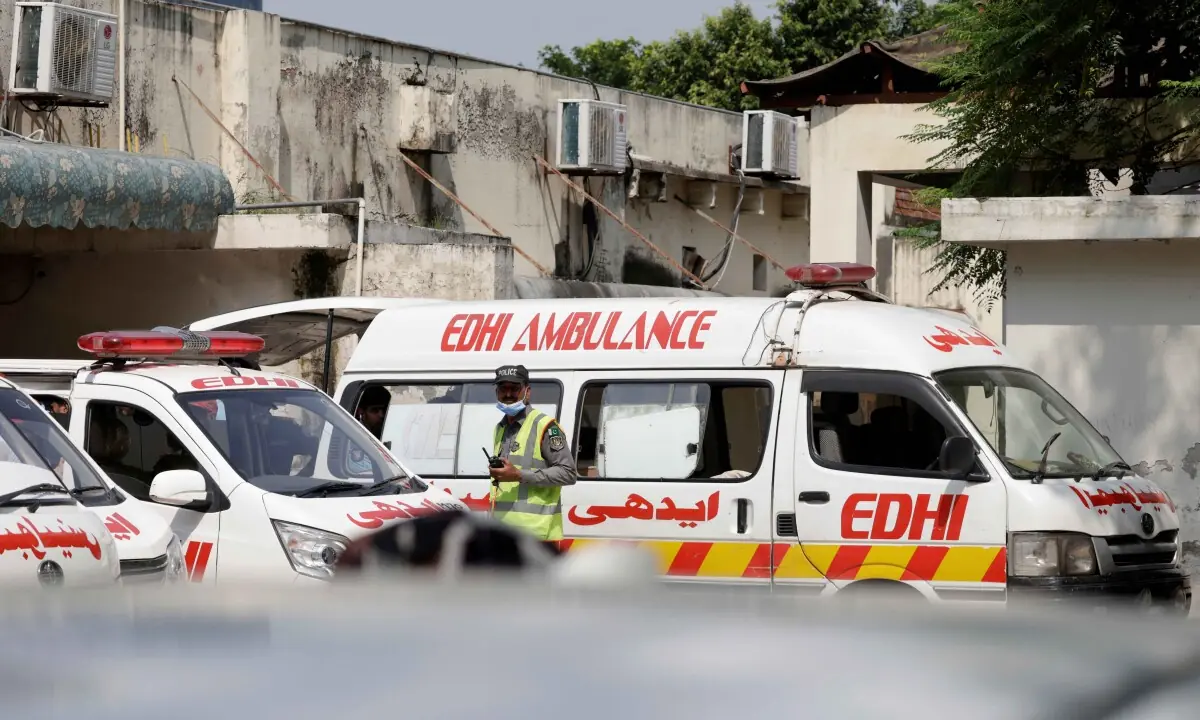
Fourteen newborn babies died in a fire at PIMS.
That single sentence should shake Pakistan’s entire system of governance.
These were children who had just entered the world. Their parents had brought them to one of the country’s most important public hospitals—not in a remote and neglected corner of Pakistan, but in the heart of the federal capital. They were supposed to be under the protection of an institution overseen by the federal government. Instead, a fire turned a place meant to save lives into a scene of unimaginable tragedy.
An inquiry has been ordered. A secretary has been suspended. Committees will investigate. Questions will be asked about fire safety, emergency preparedness, evacuation arrangements and negligence. But Pakistan has seen this script before.
A tragedy occurs. An inquiry is announced. A few officials are suspended or transferred. Strong statements are issued. Promises are made that those responsible will not be spared. Then the system moves on.
That is why the PIMS tragedy should not be viewed merely as an isolated incident or a case of individual negligence. The inquiry must establish exactly what happened and who was responsible. But there is a larger question Pakistan must confront: What does this tragedy tell us about the capacity of the Pakistani state to govern?
The question is particularly relevant at a time when serious discussion is taking place about creating smaller provinces and administrative units.
In principle, smaller provinces are a good idea. Pakistan is a large, diverse and heavily centralised country. Many regions have legitimate complaints that decisions affecting them are made hundreds of kilometres away by governments and bureaucracies with little understanding of local realities.
Bringing administration closer to the people could improve representation, speed up decision-making and ensure that neglected regions receive greater attention. But there is one fundamental question: Who will run these new units?
If the answer is the same bureaucracy, operating with the same culture, outdated structures and lack of meaningful accountability, the entire exercise may prove futile. Pakistan could simply multiply its existing failures.
The PIMS tragedy should serve as a warning. If the federal government cannot effectively manage and supervise major public institutions in Islamabad, what confidence should people have that the same administrative machinery can successfully govern new units in Pakistan’s far-flung regions?
This is Islamabad—the seat of the federal government. It is where ministers, secretaries, senior bureaucrats, parliamentarians and policymakers live and work. It should be the showcase of Pakistan’s administrative capacity. Yet look at the condition of the capital.
Potholes are visible on major roads. In the Markaz areas of some of Islamabad’s most expensive and supposedly well-planned sectors, pedestrians often have to navigate dirt, overflowing waste and unpleasant smells. Stray dogs roam roads and parks. Street lighting is frequently inadequate. Traffic signals malfunction. Parks that should be among the capital’s greatest attractions are neglected. The law-and-order situation is also becoming a growing concern.

Islamabad is not a sprawling province. It is a relatively compact capital territory, stretching roughly 28 kilometres from one end to the other. Yet the system appears incapable of managing even this effectively.
So before celebrating the creation of smaller provinces, someone needs to answer a brutally simple question: If this system cannot properly govern major public hospitals and a 28-kilometre-long capital city, how will it efficiently govern new administrative units in the most remote areas of Pakistan?
The answer cannot simply be to hire more bureaucrats. That is precisely how Pakistan has reached this point. Whenever an institution fails, another department is created. Whenever a department becomes ineffective, another authority emerges. Whenever there is a crisis, the bureaucracy expands. More employees. More offices. More funds. More vehicles. More layers of approval. But not necessarily better governance.
The Capital Development Authority illustrates this contradiction. Islamabad continues to face visible problems of urban management, yet the institutions responsible for managing the city continue to grow. The bureaucracy becomes fatter while the city becomes increasingly difficult to manage.

This is the fundamental problem with Pakistan’s administrative system. It has become too comfortable with survival and too disconnected from performance. The system often rewards seniority over competence, caution over initiative and obedience over results. A bureaucrat who avoids taking a decision may face fewer consequences than one who takes a bold decision that goes wrong. Files move from one desk to another because avoiding responsibility is often the safest bureaucratic strategy.
And when failure occurs, responsibility disappears into a maze of ministries, departments and authorities. A road develops potholes. Who is responsible? A traffic signal stops working. Who is answerable? A park deteriorates. Whose job was it to maintain it? Garbage accumulates in a commercial centre. Who should be held accountable? The ordinary citizen rarely knows. And that is exactly how the system protects itself. When everybody is responsible, nobody is responsible.
The PIMS tragedy brings this failure into painful focus. A newborn child is completely dependent on the institution responsible for its care. If basic safety arrangements, emergency systems or evacuation procedures failed—as the inquiry will determine—this cannot simply be dismissed as an administrative lapse. It represents a catastrophic failure of governance.
Pakistan should not allow the matter to end with the punishment of a few lower-ranking officials while the larger system remains untouched. The more important question is why the system repeatedly fails to prevent disaster before disaster happens. That is the question policymakers must answer before creating new provinces.
There is a serious danger that Pakistan will simply replicate its existing provincial model. Instead of four provincial bureaucracies, it could have eight or ten. Each new province would demand its own departments, ministers, advisers, offices, residences, development authorities and thousands of government employees. Would that necessarily produce better governance? Or would it simply create more expenditure, more layers of administration and more opportunities for inefficiency and corruption?
Smaller provinces should mean smaller, more efficient and more accountable governments. They should not mean multiplying the same administrative culture that has failed institutions such as PIMS and struggled to manage even the federal capital.

Pakistan should use the debate over new administrative units as an opportunity to reform the state itself. Recruitment should prioritise competence and specialised expertise. Promotions should depend on measurable performance, not merely years spent in service. Officials should have clearly defined responsibilities, targets and consequences for failure.
If a hospital is unsafe, someone should be answerable. If a road remains broken for months, someone should be answerable. If a park deteriorates, someone should be answerable. If streetlights disappear and traffic signals stop functioning, citizens should know exactly who has failed to do the job.
Technology can also reduce the layers of bureaucracy that have turned ordinary government decisions into endless journeys through files and offices. Most importantly, the culture of impunity must end. A public servant should not be judged by the size of his office, the number of people reporting to him or the power attached to his designation. He should be judged by a simpler standard: What did you deliver?
The creation of smaller provinces could still become one of the most important reforms in Pakistan’s history. It could bring government closer to neglected populations and create more responsive administrative structures. But boundaries alone cannot reform a state.
Drawing new lines on a map will not change the attitude of the people sitting behind government desks. A new province run by the old bureaucracy will simply become old Pakistan with a new name.
The deaths of those 14 newborn babies must become more than another statistic followed by another inquiry that eventually disappears into the archives. Their deaths should force Pakistan to examine a machinery of government that repeatedly reacts to catastrophe but too often fails to prevent it.
Before Pakistan divides its provinces, it must reform the institutions that will run them. Before creating more offices, it must ask whether the existing ones are working. Before hiring more bureaucrats, it must ask why the current bureaucracy has failed so badly. And before creating new administrative units in the farthest corners of Pakistan, the government should first demonstrate that it can properly govern its own capital.
Reform before you divide. Because if Pakistan cannot effectively manage PIMS and Islamabad, creating smaller provinces without transforming the system of governance will not solve the problem. It will simply spread the problem across a larger map.

