

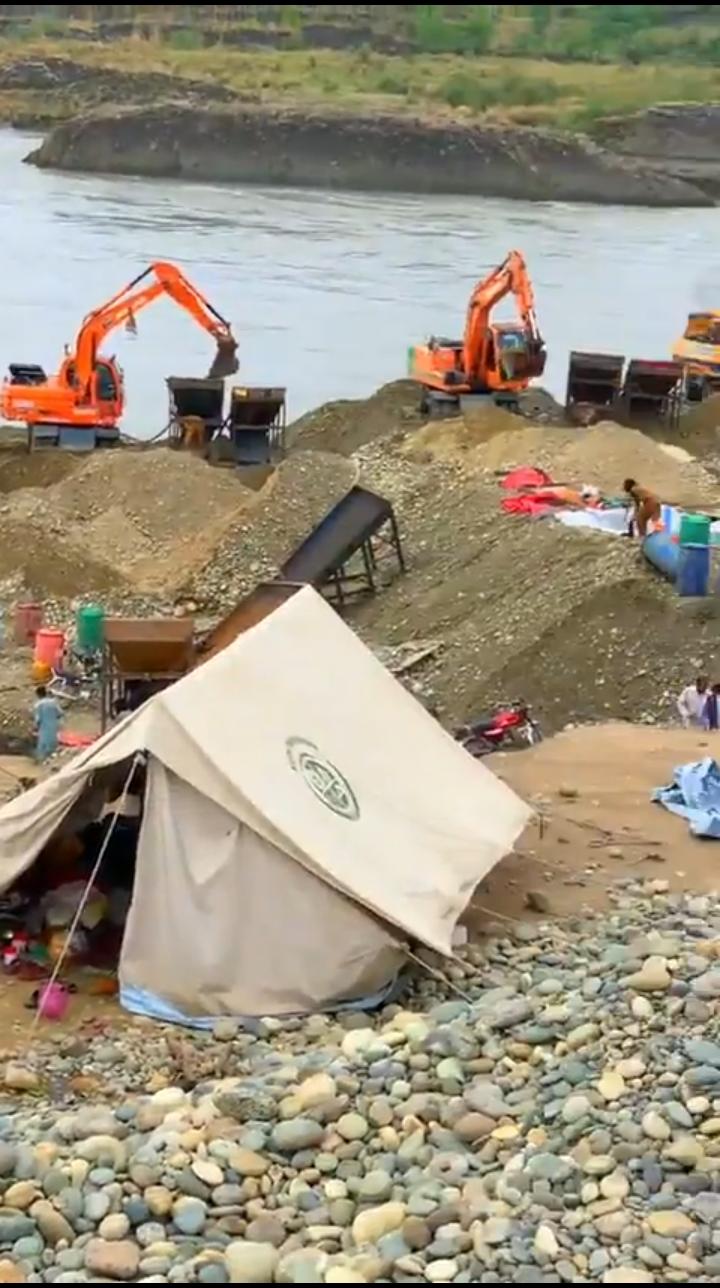
PESHAWAR – Khyber Pakhtunkhwa, a province blessed with enormous natural resources but already struggling with poverty, underdevelopment and the devastating effects of terrorism, appears to have become another victim of institutional confusion and administrative experimentation.Thousands of people and heavy machinery are reportedly engaged in illegal mining of placer gold in different parts of the province, raising serious questions about the protection of the province’s precious mineral resources and the loss of revenue to the national exchequer.
What makes the situation more disturbing is the manner in which the legally conducted auction of five placer gold blocks was handled.Around one and a half years ago, the National Accountability Bureau (NAB) suddenly initiated an inquiry into the placer gold auction process and raised objections over the five blocks auctioned by the provincial government through what officials maintained was a transparent process.The inquiry resulted in repeated appearances of senior officials of the Mines and Minerals Department, including the Director General and Secretary Mines, and reportedly even the Chief Secretary Khyber Pakhtunkhwa.Meanwhile, investors who had reportedly secured leases after investing billions of rupees, estimated at around Rs 5 to Rs 6 billion, were prevented from commencing their mining operations.The development not only caused serious concern among investors but also damaged investor confidence in the province.
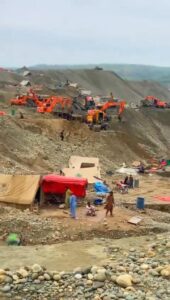
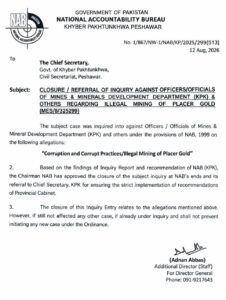
The auction of the remaining blocks was also reportedly stalled.And what happened next raises an even more serious question.While the legally auctioned blocks remained caught in an inquiry and investors were kept away from their operations, illegal mining activities reportedly expanded, with thousands of individuals and machinery becoming involved in the extraction of gold.The situation effectively created a paradox: legal investors were stopped, while illegal miners allegedly continued extracting the province’s valuable natural resources.Now, after approximately one and a half years of investigation, NAB has reportedly closed the inquiry, giving the Mines and Minerals Department a clean chit and declaring the auction process of the five blocks to be lawful and proper.This development, however, raises a fundamental question: If the auction process was ultimately found to be correct, who will be held responsible for the loss of one and a half years of precious time?
Who will compensate the investors whose billions of rupees remained tied up?
Who will account for the loss of investor confidence?
Who will calculate the revenue that the provincial government could have generated had the remaining blocks been auctioned and mining activities allowed to proceed?.
And, most importantly, who will be held responsible for the alleged illegal extraction of gold during the period when the legal mining process remained suspended?
The issue is not merely about an auction or an administrative inquiry.It concerns the management of Khyber Pakhtunkhwa’s natural resources, the credibility of government institutions and the protection of public revenue.An accountability process is undoubtedly necessary whenever allegations of irregularity arise.But accountability is not merely about opening an inquiry; it is equally about concluding it within a reasonable time and ensuring that the inquiry itself does not cause greater public loss than the alleged irregularity under investigation.In the present case, if the auction process has now been declared correct, serious questions arise regarding the institutional cost of the prolonged investigation.Khyber Pakhtunkhwa is already facing terrorism, unemployment, poverty and severe economic challenges.Its mineral resources could provide an important source of revenue, employment and investment.However, if legal investors are discouraged, auctions are delayed and illegal mining flourishes, the ultimate loser is not an individual department, it is the people of Khyber Pakhtunkhwa and the national exchequer.
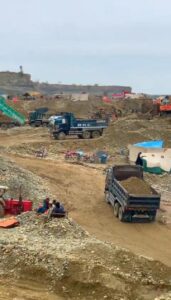
The province increasingly appears to have become an experimental ground where provincial and federal institutions take decisions independently, without fully considering their cumulative impact on the people and economy of the province.Whether it is the provincial government, federal government, NAB or other regulatory institutions, every decision concerning KP’s natural resources carries a direct public cost.Gold and other mineral resources are not the property of any particular government, department or institution.They are public and national assets, and their exploitation must be governed by transparency, continuity of policy, investor protection and the overriding interest of the people.With NAB having now closed the inquiry and declared the auction process proper, the ball appears to have returned to the court of the provincial government.But the fundamental question remains unanswered: Who will account for the precious time lost, the investment disrupted, investor confidence damaged, delayed auctions and the alleged illegal mining that reportedly continued during this period?
And if nobody is accountable for the loss of public resources and precious official time, then the people of Khyber Pakhtunkhwa may reasonably ask: Where should the people of KP take their case against such institutional failure?
This is no longer merely a question about gold mining. It is a question about accountability, institutional responsibility and the future of Khyber Pakhtunkhwa’s precious natural resources.

