

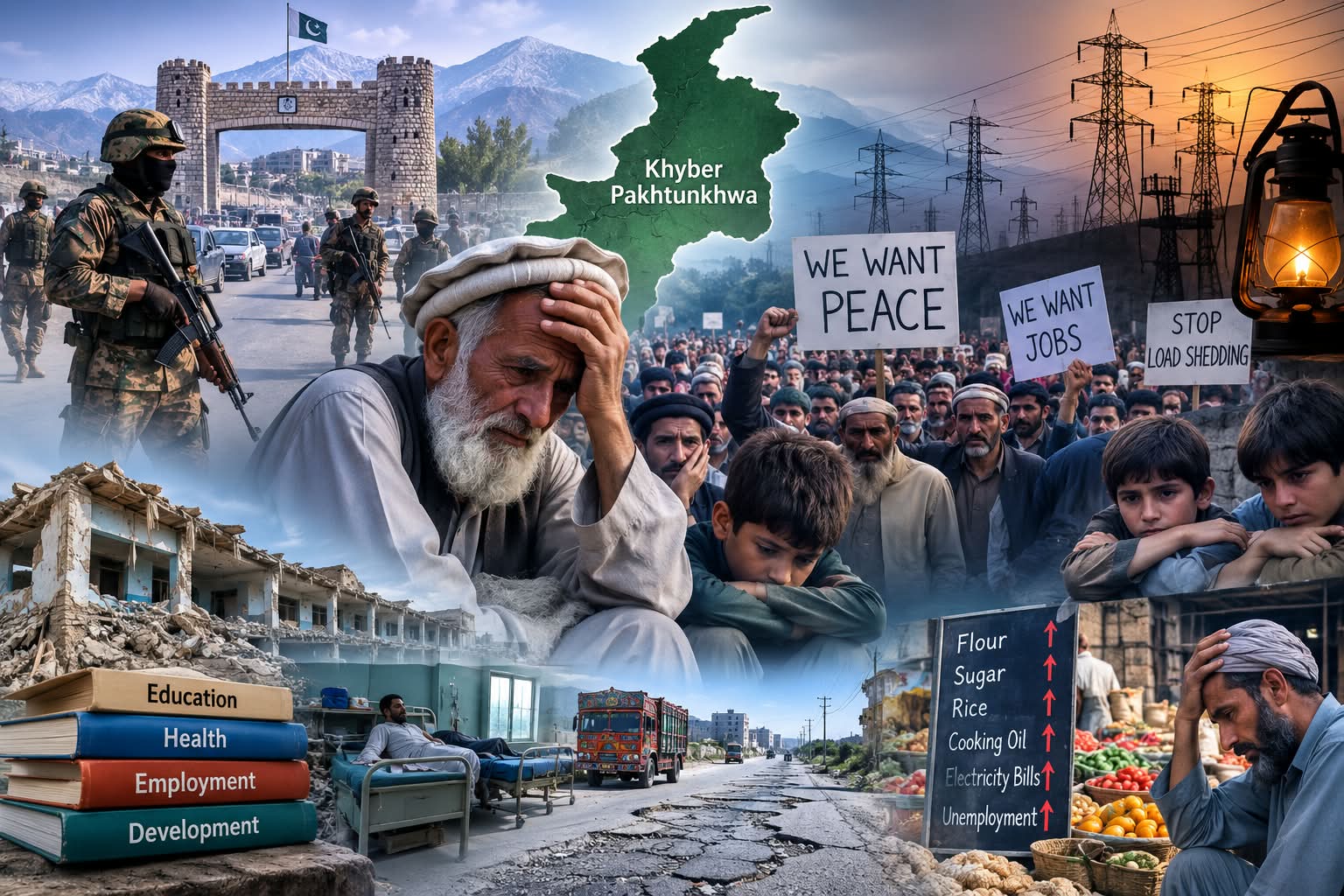
PESHAWAR – Khyber Pakhtunkhwa is facing a crisis that extends far beyond terrorism and law and order challenges.Persistent insecurity, economic hardship, unemployment, prolonged power outages, high electricity bills, disruptions in Pak Afghan trade, agricultural difficulties, strained health and education systems, delayed justice and political uncertainty have collectively placed a heavy burden on ordinary citizens.For the people of the province, the challenge is no longer limited to the question of security.They increasingly seek peace with dignity, employment, justice, affordable basic services and a realistic opportunity for a better future.Over the past two decades, Khyber Pakhtunkhwa has paid an enormous human and economic price for terrorism.Thousands of lives have been lost, while businesses, investment, education, employment and normal social life have suffered repeated setbacks. Continued security concerns have also contributed to a persistent sense of fear and uncertainty, making sustainable economic activity and investment increasingly difficult.
The disruption of Pak Afghan trade has further aggravated the situation, particularly in districts adjoining the Afghan border.Traders, transporters, drivers, daily wage workers and small businesses dependent on cross border commerce have suffered significant losses.Farmers and growers who rely on Afghan markets for their agricultural produce are also facing serious difficulties as restricted access to markets affects prices, sales and household incomes.The province’s rural economy is under additional pressure.Farmers are struggling with rising costs of seeds, fertiliser, electricity, diesel, water and agricultural inputs, while securing a fair price for their produce remains another major challenge.When farmers fail to recover their costs and earn a reasonable return, their ability to invest in the next crop is also compromised, ultimately affecting rural employment, food security and the wider economy.
The business community is facing a similarly difficult environment.Insecurity, unreliable electricity, high power bills, taxation, inflation, declining purchasing power and administrative complications have made it increasingly difficult for small traders and entrepreneurs to sustain their businesses.Prolonged scheduled and unscheduled power outages are particularly damaging to workshops, small industries, flour mills, tailoring units, welding workshops, refrigeration businesses and other electricity dependent enterprises.
For ordinary households, inflation has become one of the most immediate challenges.Rising prices of food, electricity, education, healthcare, rent and other necessities have placed even middle income families under severe financial pressure.Daily wage workers remain among the most vulnerable, as any slowdown in business activity directly translates into a loss of income and, in many cases, difficulty in meeting basic household expenses.
The education and healthcare sectors are also under considerable strain.Educational institutions continue to face challenges relating to infrastructure, shortage of teachers, quality of education and unequal access to facilities, particularly in remote areas.At the same time, overcrowded public hospitals, shortages of medicines and medical facilities and limited access to quality healthcare in far-flung districts continue to affect vulnerable communities.For a poor family, illness is increasingly becoming not only a medical emergency but also a serious financial crisis.
The situation facing the province’s youth is particularly concerning.Despite increasing numbers of educated young people, employment opportunities remain limited, while perceptions of weak merit and unequal access to opportunities are contributing to frustration and uncertainty about the future.Their basic expectations are straightforward: quality education on merit, employment on merit and a secure future.The lack of these opportunities is also encouraging many young people to look abroad for employment and a more predictable future.
Women, particularly those living in rural and remote areas, continue to face limited access to education, skills development, safe employment and economic opportunities.
Government employees, meanwhile, are struggling with rising living costs, while complaints regarding political interference, transfers and promotions can undermine institutional efficiency and employee confidence.Journalists, lawyers, transporters, drivers, small industrialists and other professional groups are also confronting the wider consequences of instability.Journalists in particular continue to perform their responsibility of highlighting public grievances and holding authorities accountable despite security concerns and economic pressures.Meanwhile, prolonged litigation, rising legal costs and complicated procedures can make timely justice inaccessible to ordinary citizens.
Amid these challenges, political confrontation between the provincial and federal governments risks diverting attention from issues that directly affect people’s lives. Political differences are a natural part of democratic governance, but basic public concerns must remain above partisan disputes.For the ordinary citizen, the most important questions are simple: When will electricity become reliable? When will trade return to normal? When will businesses become viable again? When will quality healthcare and education become accessible? When will jobs be available on merit? And, above all, when will peace and security become a permanent reality?
Khyber Pakhtunkhwa therefore needs more than political statements, announcements and promises.It requires a coordinated and measurable policy response covering security, employment, investment, Pak Afghan trade, agriculture, electricity, education, healthcare, justice and administrative reform.Investors need security and legal protection; traders need a predictable business environment; farmers need functioning markets and fair prices; workers need employment; students need a future; patients need treatment; women need meaningful economic opportunities; and citizens need justice, security and dignity.The people of Khyber Pakhtunkhwa have already paid a heavy price for terrorism, instability and economic hardship.The real test now is whether the state and governments can translate their promises into peace, economic opportunity, justice and improved public services.The crisis in Khyber Pakhtunkhwa is no longer merely a crisis of law and order.It is increasingly a test of the relationship and trust between the state and its citizens and that test will ultimately be judged not by speeches, but by the tangible improvement in people’s daily lives.

