

Abbottabad / Rawalpindi / Islamabad: The tragic incident in which a mother and her daughter fell into an open manhole at Bhati Gate, Lahore, and lost their lives was not only a catastrophe for one family but also raised serious questions about our collective conscience and institutional performance. Such tragedies are not merely accidents; rather, they are the result of years of negligence, poor supervision, and a lack of accountability. In this context, the timely, courageous, and extraordinary decision taken by Punjab Chief Minister Maryam Nawaz Sharif is a clear indication that Punjab has now entered an era of practical action rather than mere statements.
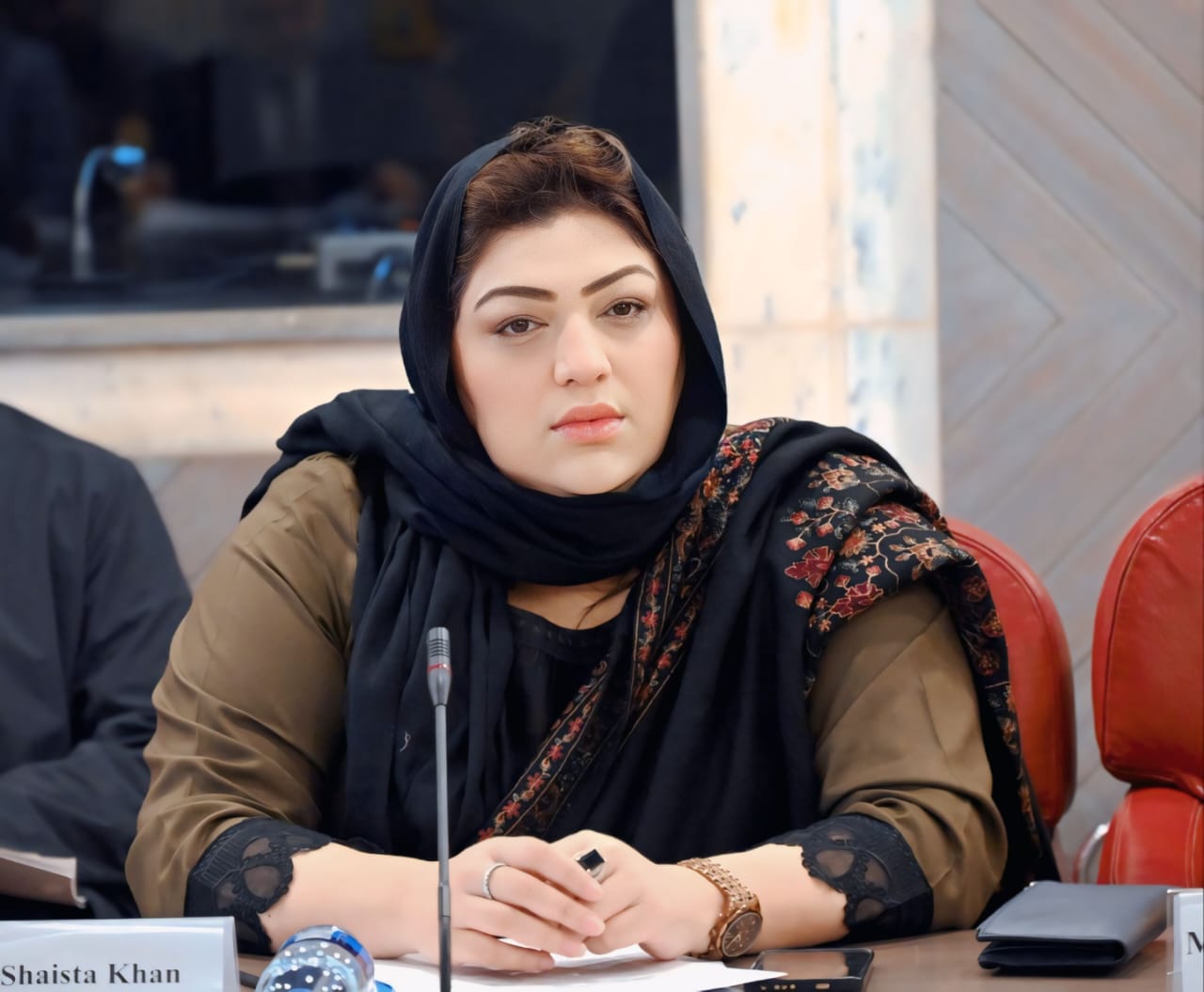
These views were expressed yesterday by Dr. Shaista Khan Jadun, Member of the National Assembly, during an exclusive conversation with media representatives. She said that she not only appreciates this historic decision by Punjab Chief Minister Maryam Nawaz Sharif but also considers it an example which, had it been followed in the past as well, would have made our country largely free of corrupt,

irresponsible, and incompetent elements today. This decision negates the notion that everything is forgotten after coming into power. Maryam Nawaz has proven that authority is a trust of the people, and there will be no leniency for those who betray this trust.
She stated that the manner in which responsible officers were questioned in the high-level meeting chaired by the Chief Minister after the incident has laid the foundation of a new tradition in our system. The Chief Minister’s blunt question to an officer who offered a formal “sorry” — “Will your sorry bring the mother and daughter back to life?” — was not merely a sentence, but a declaration that the time for tokenism and formal apologies is over. It was a moment when institutional apathy was shown a mirror.
Dr. Shaista Jadun said that the Punjab Chief Minister ordered the recovery of one crore rupees directly from the contractor responsible for the incident and directed that the amount be given to the family of the deceased mother and daughter. Along with this, the arrest of five responsible individuals, their permanent dismissal from service, and their disqualification from any future government employment are strict decisions rarely seen in the past. These measures send a clear message that in Punjab, the value of a human life will no longer be reduced to a mere file or report.
She said that the most unfortunate aspect is that in such incidents, institutions often absolve themselves by shifting responsibility onto one another. Municipal bodies, contractors, supervisory departments, and the police all escape accountability by citing jurisdictional limits. However, Maryam Nawaz has broken this tradition. She reminded institutions that the protection of public life and property is not the responsibility of a single department but a collective responsibility of the state. That is why she ordered the strictest punishment for criminal negligence.
She further stated that, in continuation, strict notice was taken of the police conduct in the Bhati Gate incident. According to reports, taking the victim’s husband and brother-in-law into custody on a rescue call, subjecting them to torture, and forcibly extracting confessions are not only illegal acts but also reflect deeply rooted flaws in police culture. In response to a question, Dr. Shaista Khan Jadun, MNA, said that on the Chief Minister’s instructions, SHO Bhati Gate Zain Abbas was suspended, and a show-cause notice was issued to the DSP. The announcement of a high-level inquiry under the supervision of the SP City is proof that even the uniform is no longer above accountability.
She added that the DIG Operations’ decision to write to the IAB for an independent inquiry is a positive step; however, it is also true that such measures only prove effective when political leadership is strong. Dr. Shaista Jadun said that Maryam Nawaz’s leadership has instilled confidence that the investigations will not be mere paperwork, but that those responsible will be taken to their logical conclusion. The inquiry will also determine why police action took place during the rescue operation and on whose orders — questions that have been suppressed for years.
However, it must also be made clear that institutional reform cannot be achieved merely by suspending a few officers. It requires strong political will, a clear policy, and consistent oversight. The manner in which the Punjab Chief Minister recommended that the IAB complete the investigation at the earliest reflects this very resolve. The announcement of strict action against all officers involved in the reprehensible conduct, in light of the investigation, is a practical step toward institutional reform.
She said that unfortunately, institutions in our country often remain under the influence of powerful circles, forcing ordinary citizens to wander from door to door in search of justice. Maryam Nawaz’s decision dispels the perception that power exists to protect the elite. She has made it clear that whether it is a contractor or an officer, if even a single life is lost due to negligence, accountability will follow. This is the very mindset that strengthens the state.
The Member of the National Assembly further stated that she says with full conviction that if similar decisions had been made in the past, if institutions had been restrained in time, then today open manholes, broken roads, and life-threatening negligence would not have become routine in our cities. The suffering inflicted upon the public by institutional incompetence can only be remedied when political leadership is fearless. Maryam Nawaz has proven that she does not accept pressure and will not compromise on public interest.
She added that it is also a fact that some circles try to label such strict decisions as “political point-scoring.” However, she questioned: is protecting human life political point-scoring? Is punishing the responsible individuals politics? If so, then such politics should be a matter of pride. The public now seeks results, not slogans, and Maryam Nawaz’s actions are the first strong step toward tangible outcomes. We also want such bold steps to be taken in Khyber Pakhtunkhwa as well.
The message conveyed against administrative negligence in Punjab gives hope that such conduct will not be seen again in the future. When contractors know that the cost of negligence runs into crores and permanent dismissal from service, and when officers realize that the word “sorry” is not enough, the system will automatically begin to move in the right direction.
In conclusion, Member of the National Assembly Dr. Shaista Khan Jadun said that she once again pays tribute to Punjab Chief Minister Maryam Nawaz Sharif for not only fulfilling her right as Chief Minister but also for feeling the pain of the people of Punjab like a mother. Holding institutions accountable is not easy, but that is the true test of leadership. She expressed confidence that if this approach continues, Punjab will become a safe, responsible, and accountable province — the very change the public has been waiting for for years.
