

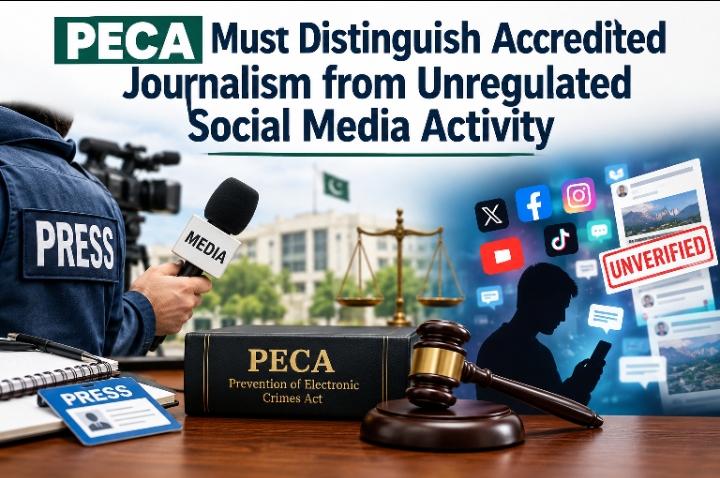
ISLAMABAD – The implementation of Pakistan’s Prevention of Electronic Crimes Act (PECA) requires a clearer legal and institutional distinction between accredited professional journalists working for recognised media organisations and unregistered, non-professional social media users who disseminate unverified or irresponsible content.
The issue is not a demand for immunity for journalists.Rather, it concerns the protection of lawful, good faith and professionally conducted journalism from unnecessary legal consequences arising from the wider misuse of digital platforms.Under PECA, certain forms of knowingly false digital content can constitute an offence.However, the law should be applied with due regard to the nature of the conduct, intent, evidence and circumstances of publication.
An accredited journalist working for an established newspaper or news organisation, who reports a matter of genuine public interest after reasonable verification, relies on available evidence, identifies allegations as allegations and seeks the version of the concerned person before publication, should not automatically be placed in the same legal category as an individual who deliberately creates, circulates or amplifies unverified or fabricated content through an unregistered social media platform.
The Protection of Journalists and Media Professionals Act, 2021 recognises the State’s responsibility to protect the independence, safety and freedom of expression of journalists.It also requires journalists to act in good faith and not knowingly disseminate false material.
It is therefore the responsibility of the government and relevant regulatory authorities to develop a clear and workable legal mechanism so that professional journalism and unlawful digital activity are not unnecessarily conflated.Appropriate safeguards should ensure due process before criminal proceedings are pursued against accredited journalists for bona fide public interest reporting, while deliberate fabrication, malicious misinformation, impersonation and other unlawful digital conduct remain subject to the law.

The distinction should be based not merely on a person’s claim to be a journalist, but on professional accreditation, affiliation with a recognised media organisation, journalistic conduct, verification, intent and compliance with applicable law.
The objective should be neither to place journalists above the law nor to leave social media activity unregulated.The objective should be to ensure fair accountability, protection of legitimate journalism and effective action against deliberate digital abuse.
The government must address this gap so that the irresponsible conduct of unregistered and non professional social media operators does not result in bona fide accredited journalists being unnecessarily subjected to legal proceedings for carrying out their lawful professional responsibilities.

