

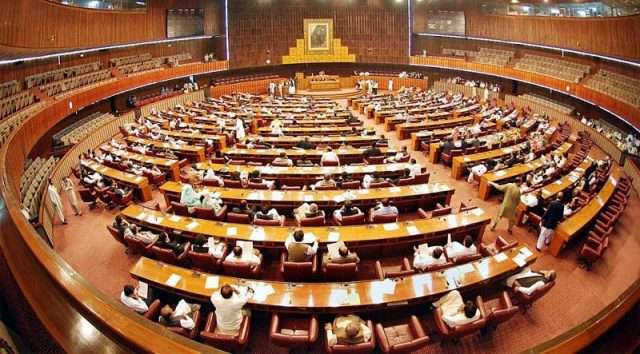
Islamabad : Presidential System and the new provinces likely to the daylight.
Establishment believes Westminster model has failed to deliver; debate underway over sweeping political and administrative restructuring. Pakistan could be heading towards a major political and administrative restructuring, with a presidential form of government and the creation of new provinces or administrative units reportedly being considered as part of an effort to overhaul a system increasingly viewed within the establishment as incapable of delivering effective governance.
A retired general, who spoke to The Newsman on condition of anonymity, said there was growing concern within the rank and file of the armed forces that Pakistan’s existing political system had failed to produce the stability, accountability and administrative efficiency required by the country.
“There is a huge concern among the rank and file that the current system is simply not capable of delivering. There is a growing feeling that the system needs to be fundamentally reformed,” the former general said.
According to him, the thinking extends beyond merely changing governments or introducing piecemeal administrative reforms. A presidential model, coupled with smaller provinces or administrative units, is among the options being discussed in the broader establishment.
The retired general said the argument being advanced by proponents of such a change was that Pakistan needed a system capable of producing continuity in governance and holding political leadership directly accountable for performance.
“The issue is not personalities. The issue is the system. Governments come and go, political parties fight each other, but the ordinary citizen continues to suffer because governance does not improve,” he said.
The former military officer also made an unusual comparison between the internal culture of the armed forces and Pakistan’s major political parties, arguing that the military’s hierarchical structure does not necessarily mean that questioning is discouraged.
“In fact, the culture within the armed forces is more democratic than that of most political parties and political dynasties in Pakistan,” he said.
“Nobody can dare question the leadership of PML-N, PPP, PTI or any other major political party about a decision taken at the top. The leadership is rarely challenged from within. But in the armed forces, a second lieutenant can ask a question from the Army Chief, and the Army Chief is expected to answer and satisfy the officer.”
He said this institutional culture of questioning and accountability was one reason why sections of the establishment believed Pakistan needed to rethink the Westminster parliamentary model it had inherited.
“There is a feeling in the establishment that Westminster-style democracy, in the form in which it operates in Pakistan, is not fit for the country,” he said.
The former general said supporters of this view often cited the political instability witnessed in Britain itself, the country from which the Westminster system originated.
“Look at the United Kingdom. It is considered the mother of Westminster democracy, yet it has gone through several changes of prime minister in the last decade. The argument here is that Pakistan, with its much more serious economic, security and governance challenges, cannot afford a system that produces constant political instability,” he said.
The retired officer maintained that the proposed restructuring should not be viewed simply as an attempt to strengthen the executive.
“A presidential system by itself will solve nothing. You need institutional reform alongside it. You need effective local governments, smaller administrative units, professional bureaucracy and a system where an elected leadership is actually responsible for what happens on the ground,” he said.
The creation of new provinces or administrative units is therefore being discussed as an important part of the broader reform debate.
uThe argument is that Pakistan’s existing provinces have become too large and administratively unwieldy, resulting in excessive centralisation of political and bureaucratic authority. Smaller units, proponents believe, could bring government closer to citizens and improve the delivery of health, education, policing, municipal services and other basic functions.
When told that creating new provinces would be politically far more complicated than redrawing administrative boundaries. It would require constitutional amendments and could trigger intense negotiations over political representation, resources, provincial assemblies, Senate seats and territorial boundaries.
The retired general acknowledged that powerful political interests could resist any attempt to fundamentally restructure the existing system.
“Those who benefit from the existing arrangement will naturally resist change. But the question is whether the system should be designed around the interests of political families and elites or around the needs of ordinary citizens,” he said.
He also cautioned against assuming that simply creating smaller provinces would automatically improve governance.
“If you create ten provinces but leave the same bureaucracy, the same political culture and the same institutions untouched, nothing will change. You will simply have more chief ministers, more ministers and more bureaucrats,” he said.
According to him, the objective should be to create a governance model in which political leadership is directly accountable for performance and administrative units have sufficient autonomy to respond to local problems.
“The test of any system is very simple: can it deliver? Can it provide decent hospitals, schools, policing, municipal services and justice? If it cannot, then people have every right to ask whether the system itself needs to change,” he said.
He said the current debate should therefore not be reduced to a confrontation between parliamentary and presidential camps.
“This is not about whether one system is fashionable or another is old-fashioned. Pakistan needs to decide what works for Pakistan,” he said.
The retired general’s comments could not independently be verified and there is, as yet, no official announcement confirming a decision to replace the parliamentary system with a presidential form of government or establishing a specific timetable for the creation of new provinces.
However, his assessment provides an insight into the thinking of at least some former senior military officials and comes amid an increasingly vocal debate over Pakistan’s governance structure.
If such proposals eventually move from informal discussions to a formal constitutional package, they could trigger one of the most consequential political debates in Pakistan in decades.
The central question may ultimately be less about parliamentary versus presidential government and more about whether Pakistan is prepared to undertake the institutional reforms necessary to make whichever system it chooses actually work.

