

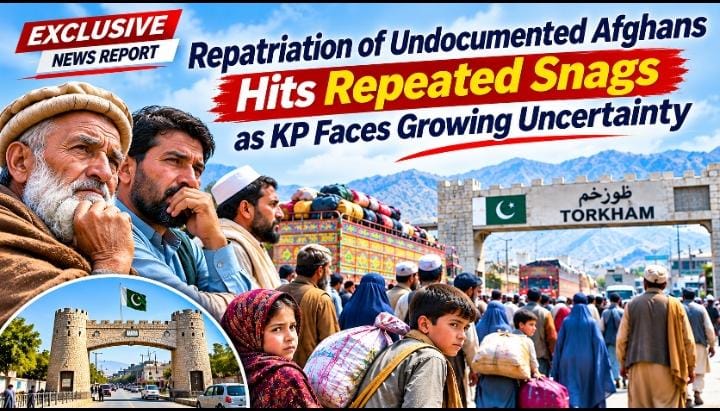
PESHAWAR – The repatriation of undocumented Afghan nationals from Khyber Pakhtunkhwa has once again run into uncertainty, with repeated disruptions, closure of key border crossings and continuing tensions along the Pakistan Afghanistan border raising concerns among citizens about the effectiveness and continuity of the government’s policy.
While the federal government has announced and repeatedly reiterated its decision to repatriate undocumented foreign nationals, the implementation of the policy at the provincial level appears to be facing serious operational challenges.The repeated interruptions in the repatriation process, particularly amid the closure of the Torkham border, have created uncertainty not only among Afghan families awaiting return but also among residents of Khyber Pakhtunkhwa who are closely watching developments along the border.
The situation on the ground presents a contrast between official claims of continued action and the perception in various parts of the province that the process has not been maintained with the consistency and continuity required to achieve its stated objectives.
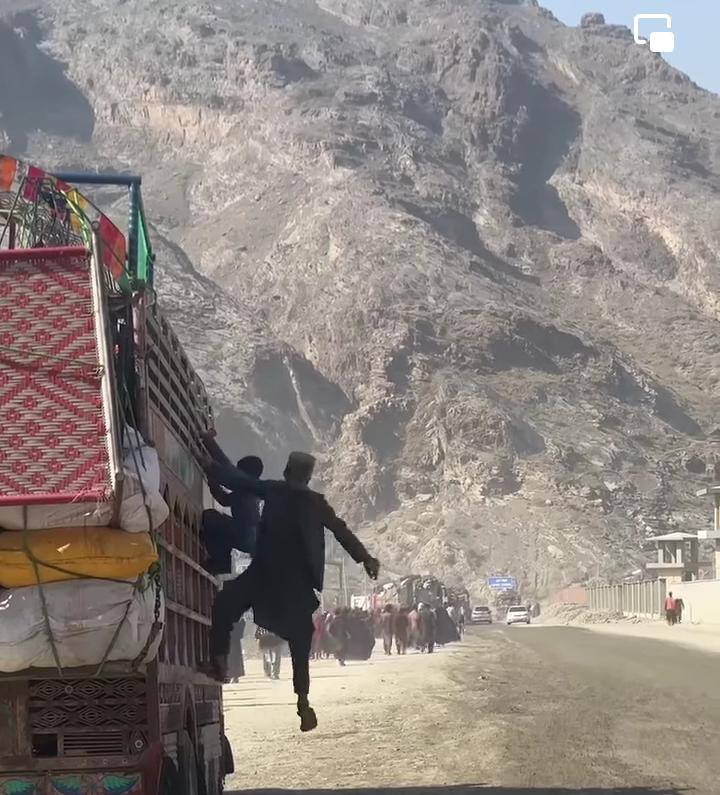
The latest disruption at Torkham following tensions and firing along the border once again affected the movement of Afghan nationals seeking to return to Afghanistan.Families waiting to cross were reportedly caught in uncertainty as the closure restricted their movement and disrupted arrangements made for their repatriation.
The recurring interruptions have also raised questions about the government’s preparedness to deal with circumstances in which border crossings are temporarily closed because of security tensions.With the repatriation process directly dependent on the availability of functioning border crossings, any prolonged closure can leave returnees stranded and place additional pressure on the provincial administration and security agencies.
The uncertainty is particularly significant for Khyber Pakhtunkhwa because of its geographical proximity to Afghanistan and its long standing social, economic and commercial links with Afghan communities.Districts including Peshawar, Khyber, Nowshera and other adjoining areas have historically hosted large numbers of Afghan nationals, making the implementation of any repatriation policy a major administrative and security undertaking.
Citizens and some political and social circles are increasingly questioning whether the federal government’s decision is being implemented with the seriousness and consistency required at the provincial level.The repeated suspension and resumption of the process has led to a perception among some sections of the public that the government’s policy could ultimately become another traditional announcement without producing sustained results on the ground.
However, such perceptions require careful assessment against the actual performance of federal and provincial institutions, as security conditions and border closures can independently disrupt the implementation of the policy.
Official figures also remain a major part of the debate. Provincial authorities have claimed that thousands of undocumented foreign nationals have been repatriated from different districts of Khyber Pakhtunkhwa during the recent drive.According to figures reported by officials, nearly 9,923 undocumented foreigners were repatriated from the province over a four-month period, including 3,657 from Peshawar, 1,107 from Khyber, 657 from Nowshera and 652 from Swabi.
While these figures indicate that enforcement operations have continued, questions are being raised over whether the official numbers accurately reflect the situation on the ground.Residents and observers argue that the number of people repatriated alone does not provide a complete picture unless the government also discloses the total number identified as undocumented, the number still residing in the province, those whose cases are under process and those who remain outside the enforcement net.
The credibility of official statistics could also come under pressure if there is a visible difference between government figures and the situation observed in urban centres and border districts. For this reason, greater transparency in district-wise and category-wise data could help address public concerns and establish a clearer picture of the progress of the repatriation drive.
The situation has become even more complicated because of the deteriorating security environment along the Pakistan Afghanistan border.Repeated tensions and clashes have affected normal cross border movement and have demonstrated how vulnerable the repatriation process remains to developments beyond the direct control of provincial authorities.
The issue is therefore no longer confined to immigration enforcement.It has become closely linked with border security, bilateral relations, trade, transport and the overall security environment of Khyber Pakhtunkhwa.
The repeated closure of Torkham and other crossing points also has economic consequences.Transporters, traders and communities dependent on cross-border commerce face uncertainty whenever border movement is suspended.For Afghan families awaiting repatriation, meanwhile, every closure creates additional logistical and humanitarian difficulties.
The government now faces the difficult task of maintaining enforcement of immigration laws while ensuring that repatriation remains orderly, legally compliant and humane.At the same time, contingency arrangements are required for situations in which border crossings are temporarily closed because of security incidents.
The central question emerging in Khyber Pakhtunkhwa is therefore not simply how many undocumented Afghan nationals have been repatriated, but whether the entire process is being implemented through a consistent, coordinated and sustainable mechanism.
If the federal decision is to achieve its stated objectives, provincial institutions will need to demonstrate sustained coordination, transparency and continuity rather than relying solely on periodic enforcement drives and statistical announcements.
For the people of Khyber Pakhtunkhwa, the repeated disruption of the process has created a wider sense of uncertainty at a time when the province is already facing serious security and economic pressures.Any perception that government decisions are temporary or inconsistently implemented could further weaken public confidence.
The Afghan repatriation issue has consequently evolved into a broader test of governance and institutional coordination.Its outcome will depend not only on the number of people returned but also on the government’s ability to maintain a transparent, consistent and credible process despite border tensions and changing security conditions.
Unless the authorities bridge the apparent gap between official claims and ground realities, the repeated interruptions in the repatriation process may continue to fuel uncertainty among the people of Khyber Pakhtunkhwa and raise further questions about the seriousness, sustainability and effectiveness of the government’s policy.

