

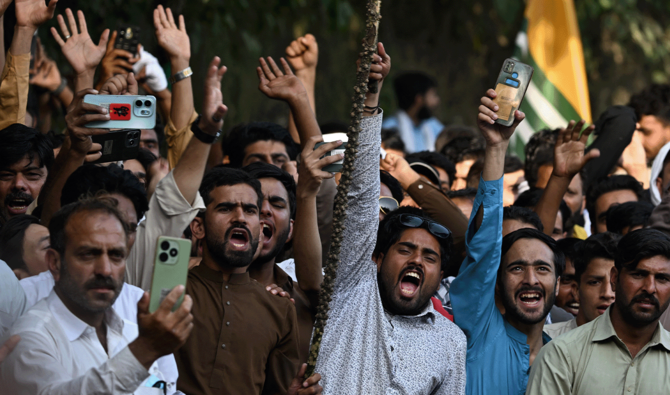
Islamabad : Political tensions are mounting across Pakistan-administered Kashmir as the Supreme Court of
Azad Jammu and Kashmir (AJK) begins hearing a GOVT. reference concerning 12 reserved seats. in the Legislative Assembly for refugees residing in Pakistan, while an indefinite protest movement called by the Joint Awami Action Committee (JAAC) is expected to begin on June 9.
The AJK government has sought the court’s opinion on the constitutional status of the 12 refugee
seats and related constitutional questions. Officials have maintained that there can be no compromise on the seats, which they describe as an integral part of the region’s constitutional and political framework. Earlier this week, the Legislative Assembly also passed a resolution
reaffirming support for retaining the seats.
The issue, however, has become the focal point of a growing dispute between the government and the Joint Awami Action Committee. The committee has rejected any compromise on the matter and announced an indefinite protest campaign, urging citizens to prepare for a prolonged movement. It has also advised residents to stock essential supplies in anticipation of possible
disruptions.
In response to the planned demonstrations, authorities have intensified security preparations. The
AJK government has requested additional personnel from Pakistan’s federal authorities, while educational institutions have taken precautionary measures. The University of Jammu and
Kashmir and the Mirpur Board of Intermediate and Secondary Education have cancelled examinations scheduled to commence on June 8.
Government officials accuse the Joint Awami Action Committee of spreading what they call a misleading narrative in the name of public concerns. A government spokesperson said the administration had consistently pursued dialogue, offered relief measures, and worked towards
implementing public demands, but alleged that the committee had opted for pressure tactics and street agitation instead of constructive engagement.
The committee, however, argues that the 12 refugee seats were not originally part of the state’s legislative structure and were incorporated later under what it describes as a particular political agenda. Its representatives further contend that lawmakers elected on these seats have historically played a decisive role in the formation and dismissal of governments in the region,
influencing political outcomes beyond their intended purpose.
As the legal and political battle intensifies, residents across the region say they are already feeling
the effects of measures taken ahead of the planned protests. Local sources told that heightened security arrangements, increased checkpoints, restrictions on movement, and disruptions to
communication services have created significant difficulties for ordinary citizens.
According to residents, concerns are growing over access to daily necessities, transportation, business activities, and educational services. Some fear that further restrictions could affect livelihoods and routine life if the situation escalates in the coming days. Locals also expressed
concern that uncertainty surrounding the protests and security measures is creating anxiety among families and business owners.
The developments have raised fears of a broader confrontation between authorities and protest
organisers at a time when the region remains politically sensitive. Observers say the Supreme Court proceedings, coupled with the planned demonstrations, could prove pivotal in determining
the future of the disputed refugee seats and the wider political landscape of Azad Jammu and Kashmir.
With the court hearings underway and protests scheduled to begin next week, all eyes are now on Muzaffarabad as the region prepares for what could become one of its most significant political
flashpoints in recent years.

