


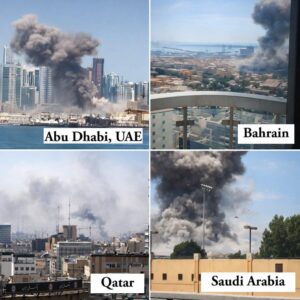
As tensions rise across the Middle East and the possibility of a wider regional conflict looms, governments around the world are preparing for uncertain times. Strategic meetings are being held, military planners are reviewing possible scenarios, and economic experts are calculating the impact of a potential war between Iran and the United States.
The confrontation between these two countries has already shaken global markets and raised fears that the region may be heading toward a dangerous escalation. For many countries, especially those located near the Gulf, the implications could be enormous.
For Pakistan, such developments are not distant geopolitical dramas. Pakistan depends heavily on imported energy from the Gulf and has millions of citizens working in Middle Eastern countries whose remittances support the national economy. Any serious conflict in the region would immediately affect oil prices, trade routes, and economic stability.
One would naturally expect Pakistan’s leadership to be focused on preparing the country for possible shocks — strengthening diplomatic engagement, planning economic contingencies, and ensuring national security readiness.
Yet the political conversation in Islamabad appears to revolve around a very different priority: how to make sure former prime minister Imran Khan remains behind bars.
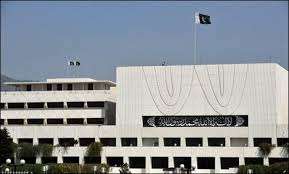
Last week, the government rushed through legislative changes related to the National Accountability Bureau, pushing them quickly through the Senate of Pakistan and the National Assembly of Pakistan before the bill received approval from President Asif Ali Zardari.
Officially, the amendments were framed as improvements to the accountability system — technical reforms meant to enhance legal clarity and administrative efficiency.
But politics rarely operates in technical language.
In Pakistan’s political environment, accountability laws often become tools of political competition. And in the present moment, the central political figure around whom much of the legal and political drama revolves is Imran Khan.
Whether one supports him or opposes him is not the issue here. What stands out is the extraordinary amount of energy that the state appears willing to invest in managing the legal fate of one individual.
Parliamentary sessions are hurriedly scheduled. Laws are amended. legal frameworks are adjusted. Institutional mechanisms are redesigned.
All to ensure that the political equation remains carefully controlled.
Meanwhile, outside Pakistan’s borders, the world is becoming increasingly unpredictable.
The confrontation between Iran and the United States has the potential to destabilize the region. Oil markets are nervous. Strategic alliances are shifting. Governments across the globe are quietly preparing for worst-case scenarios.
But Pakistan’s leadership seems preoccupied with domestic political battles.
As if this were not enough, Pakistan is already facing serious security challenges closer to home.
Along the western border, Pakistani security forces have been engaged in an ongoing conflict with militant groups operating from across the border in Afghanistan. These groups — including factions of the Tehrik-i-Taliban Pakistan — have carried out repeated attacks on Pakistani security personnel and civilians.
In many ways, the country’s armed forces are already dealing with a difficult and dangerous security environment. Soldiers are being targeted, border tensions remain high, and counter-terrorism operations continue in several regions.
Under such circumstances, one would expect the political leadership to focus on national unity and provide strong, visible support to the armed forces engaged in these operations.
Instead, the political class seems trapped in an endless cycle of legal battles and political maneuvering.It is almost as if Pakistan’s entire legal and political machinery has quietly evolved into a single-purpose system.
And that purpose is not economic reform, not governance improvement, not national security planning.
It is simply this: ensure that Imran Khan does not come out of jail.
There is something almost darkly ironic about the situation.

At a time when the global order appears increasingly unstable, Pakistan’s leadership seems convinced that the greatest threat facing the country is not regional conflict, not economic vulnerability, not rising militancy.
The greatest threat, apparently, is the possibility that one politician might walk free.
Pakistan’s political history has long been shaped by cycles of accountability and political revenge. Governments use legal mechanisms against their rivals, only to face the same mechanisms when power changes hands.
Yesterday’s rulers become tomorrow’s defendants. Yesterday’s defendants become tomorrow’s rulers.
The cycle repeats endlessly.
But what makes the present moment particularly striking is the contrast between the gravity of international developments and the narrowness of domestic political priorities.
Missiles may be flying in the Middle East. Oil prices may be climbing. Security threats may be increasing along Pakistan’s western frontier.

Yet the dominant political activity in Islamabad seems to revolve around drafting laws, filing cases, and managing court proceedings involving one man.
Meanwhile, ordinary citizens are struggling with inflation, rising electricity bills, expensive fuel, and economic uncertainty.
For them, the question is not whether one political leader defeats another. The real question is far more basic: who is actually governing the country?
In theory, governments exist to safeguard the interests of their citizens and to prepare the nation for difficult times.
But in Pakistan, governance often resembles a permanent political chess game in which the only real objective is to keep rivals out of power.
As the world nervously watches developments between Iran and the United States, and as Pakistan’s own security forces continue to confront militant threats along the Afghan border, the country’s leadership appears remarkably calm.
After all, they are busy dealing with what they seem to consider the most urgent national priority of all.
Making sure that Imran Khan stays exactly where he is.

Zalmay Azad : The author is an Islamabad -based senior journalist .

