


Zalmay Azad
Last year, I had the privilege of visiting Baku, the capital of Azerbaijan, a city where the Caspian Sea kisses the shorelines of history and modernity. My visit was not just a traveler’s journey but also a journalist’s inquiry and a student’s exploration. As someone who studies culture, politics, and music, Baku offered me more than sightseeing — it offered lessons that Islamabad, my own city, can learn if it wishes to evolve into a true regional hub.
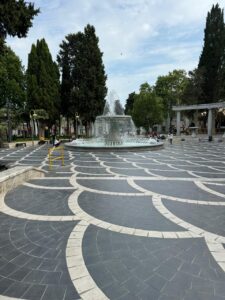
The first impression of Baku is one of order, cleanliness, and discipline. Wide boulevards lined with carefully tended trees stretch across the city, while its public spaces gleam with an attentiveness that reflects both civic pride and state responsibility. The infrastructure is modern, efficient, and aesthetically pleasing. From the seamless metro system to the well-maintained roads, Baku demonstrates how urban management can enhance not only the convenience of citizens but also the dignity of a city. In contrast,

Islamabad, despite being Pakistan’s capital and seat of power, often struggles with inadequate public transport, irregular waste management, and haphazard development. If Islamabad can borrow one lesson from Baku, it would be to cultivate an ethic of discipline in urban planning and civic cleanliness.
Culturally, Baku is an enchanting mosaic. The old city, Icherisheher, is a UNESCO World Heritage site that takes one back to the Silk Road era. Walking through its narrow stone alleys, one feels the resonance of centuries — the call of merchants, the whispers of poets, and the prayers of travelers. Surrounding this ancient core are striking modern architectural marvels, such as the Flame Towers and the Heydar Aliyev Center, designed by Zaha Hadid, which reflect a forward-looking national spirit. This juxtaposition of past and future creates a cultural landscape where tradition does not suffocate modernity, and modernity does not erase tradition. As a journalist, I found in Baku a story of balance, a narrative of a nation that has held its identity close while embracing global currents.
As a student of Indian classical music, Baku inspired me in another dimension. Azerbaijan has nurtured its own musical traditions, especially mugham — a complex and deeply expressive form of music that, like Indian ragas, flows between improvisation and structure. The soulfulness of mugham, performed in settings that range from intimate gatherings to grand concert halls, reminded me of how music can transcend borders and become a universal language. It reinforced my belief that cultural dialogue through music can enrich societies in ways politics often fails to achieve. Islamabad, though blessed with its own folk and classical traditions, has yet to create spaces where such musical heritages can flourish and be celebrated as part of civic life.
One of the most striking aspects of Baku is its cultural and religious harmony. Azerbaijan, with its majority Muslim population, has managed to cultivate an inclusive environment where mosques, churches, and synagogues coexist in peace. Religious identity here does not manifest as rigid exclusion but as a shared moral fabric. This harmony is something Pakistan, with its own diverse sects and communities, can take inspiration from. In times when intolerance often overshadows dialogue in South Asia, Baku stands as a reminder that strength lies not in uniformity but in coexistence.
Equally significant is the freedom that women enjoy in Baku. On its streets, one sees women confidently participating in every sphere of life — from education and business to arts and politics. The sight is not remarkable because it is unusual, but because it is so ordinary in Baku. For Pakistan, where women continue to face structural and cultural barriers, this empowerment offers a lesson in how societies can progress by unleashing the potential of half their population.
My visit also underscored the economic opportunities Azerbaijan offers, particularly for Pakistani investors. The energy sector, especially oil and gas, remains central, but Azerbaijan is actively diversifying. Real estate, tourism, information technology, and agriculture present growing markets. The country’s strategic location as a transit hub between Asia and Europe further enhances its attractiveness. Pakistani investors, traditionally focused on Middle Eastern markets, could benefit from tapping into Azerbaijan’s emerging economy, building trade linkages that complement cultural affinities.
Comparing Baku with Islamabad, one cannot ignore the contrasts. Islamabad is blessed with natural beauty, nestled in the foothills of the Margallas, yet it has not been able to translate this blessing into a city of international allure. Its urban culture remains fragmented, its public spaces underdeveloped, and its cultural life often subdued by bureaucratic rigidity. Baku, on the other hand, has crafted itself into a cultural capital of the Caspian — alive, clean, and vibrant. Islamabad could draw from Baku’s model: invest in cultural infrastructure, nurture inclusivity, empower women, and above all, instill civic discipline.
For me, Baku was not just a city I visited; it was a mirror that reflected what my own city could become. It inspired me as a journalist to write about urban possibilities, as a student of music to dream of cultural dialogue, and as a Pakistani to imagine a capital city that, like Baku, carries the confidence of its history into the promise of its future.

