


Imran Nasir Shaikh. Asim Riaz
In the volatile waters of South Asia in particular North Arabian Sea, the power contestation between two archrivals i.e. India and Pakistan is no longer measured in terms of numbers of fighting ships and aircraft or the sheer number of submarines. Instead, it’s a battle now in cognitive domain, of mind and maneuver, translating into maritime denial—a high-stakes chessboard. Here one side brings share mass in the shape of huge armada and the other, mobility and new employment concepts of niche technologies. In this asymmetrical equation, Pakistan has learned to punch well above its weight—turning limitations into leverage, challenges into opportunities thus, proving to the world that it’s not the size of the fleet in the battle, but employment strategy, exploitation of various domains and understanding the opponents’ strengths and weaknesses.
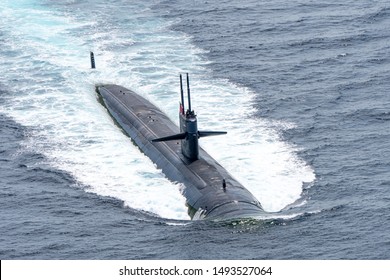
While India is poised to project its power through deployment of aircraft carriers, nuclear submarines, large number of surface ships and a blue-water navy doctrine aimed at regional dominance, Pakistan’s resolve is determined by superior and intelligent employment concepts for best situational awareness, battlefield transparency while walking on a strategic tightrope. Being fully cognizant of the fact that matching India’s blue-water naval scale remains a bridge too far, Pakistan has adopted an Anti-Access/Area-Denial (A2/AD) strategy with clearcut aim to limit India’s maritime freedom of action across full spectrum of naval warfare. This approach relies on advanced undersea platforms—most notably the Agosta and Hangor-class submarines with inherent land-attack capability—and a strategically deployed indigenously developed inventory of anti-ship missiles such as the SMASH and Harbah weapon systems. These missiles are capable of targeting high-value Indian naval assets at extended ranges with speed and precision. This contest unfolds in an environment where divergent naval doctrines collide and escalation management resides in selective targeting, superior thinking and multi domain management.
The Indian Ocean region, a vital artery for global energy supply and trade, has thus transformed into a contesting space where stealth, surprise, and sensor fusion carry as much weight as number of war fighting units. Should Pakistan acquire a system like DF-21D—often called as the “carrier killer”—or develop its own indigenous anti-ship ballistic missile, the regional calculus viz balance of power shall change overnight.

A Strategic Posture Forged by Necessity
Under the broader umbrella of grand military strategy, to combat any war, Pakistan’s maritime doctrine reflects a deliberate shift from reactive defense to proactive deterrence based upon superior employment concepts and mastering the invisible electromagnetic spectrum learing the lessons from Falklands war where Argentinian Navy despite qualitative and quantitative inferiority inflicted irreparable losses to Royel British Navy in short span of time. With matchless training, hands on experience and superior resolve, the Pakistan Navy has matured into a multidimensional force—capable of generating effects across surface, subsurface, aerial, and littoral domains with impunity.
Forward-deployed submarines patrol silently in designated areas fully armed and ready to respond to any national tasking. The maritime patrol aircraft, referred to as flying fortresses and helicopters—armed with stand-off strike capabilities—extend operational reach deep into contested waters. These platforms operate within an integrated command-and-control area sanitization for assessing any developing threat, ensuring that detection, targeting, and engagement are perfectly synchronized amongst various platforms. Here, geography becomes an ally, as Pakistan’s coastline aligns with the principal axis of likely Indian naval movement—allowing for optimal sensor coverage and early warning without requiring extended deployments. As and when and threat is indicated, despite inherent mobilization asymmetries, the Pakistan Navy rapidly aligns its posture to counter threats across all domains—air, surface, and subsurface. In this battlespace, Anti-Access/Area-Denial (A2/AD) effects are activated long before the first shot is fired. Forward presence functions not merely as deterrence but as a standing signal: any hostile advance will prompt an immediate yet, measured response. This advantage enhances maritime domain awareness and enables the Navy to anticipate and shape appropriate tactical maneuver. The weapons are then selected to cause damage where it hurts the most without touching the thresholds. This ensures in retaining escalation dominance in synch with war progression over land, as a national effort.
The Sky as an Extension of the Sea
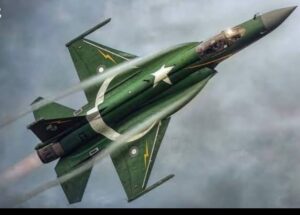
While the Pakistan Navy is tasked with deterring war at sea, it may not operate in isolation. In an integrated bi-service approach, Pakistan’s air capabilities—particularly the maritime segment of the Air Force—provide critical reach and redundancy. Armed with long-range anti-ship missiles and supported by robust electronic warfare systems, aircraft like the JF-17 Block III and modified Mirage V jets enable layered targeting and simultaneous engagement from multiple vectors using multiple platforms for achieving desired effects. The proficiency achieved thereof, has been acknowledged by major regional and international Navy’s across entire spectrum of naval warfare.
India’s edge in arial airframes and avionics—epitomized by the Rafale and Su-30MKI—remains substantial. But sustaining battle space dominance in a future fight will depend not just on platform performance but on who sees first and strikes faster. In this contest, Pakistan’s investments in ISR (intelligence, surveillance, and reconnaissance), real-time data fusion, and precision coordination offer it more than an operational equalizer.
Surveillance, First Strike, and Strategic Ambiguity
In the heart of modern naval operations is early detection. Pakistan Navy’s air arm and coastal infrastructure can surveil wide swaths of the Indian Ocean, particularly the North Arabian Sea. Detecting threats early and coordinating swift responses—alone or in joint missions with surface ships, submarines, or the Pakistan Air Force is key to success. ISR networks—featuring UAVs, satellite feeds, and coastal radars—serve as Pakistan’s maritime neural network. They allow commanders to see in real time, fuse intelligence across platforms, and target with pinpoint accuracy. In such a data-driven battlespace, situational awareness is no longer a luxury; it is a necessity. Yet Pakistan’s deterrence does not rest solely on physical hardware and platforms. Strategic ambiguity remains a cornerstone—offering plausible deniability while projecting readiness to escalate if necessary. This ambiguity functions both as shield and sword: deterring aggression without locking Islamabad into definitive thresholds.
External Actors: The China Factor and America’s Fade
China’s growing influence in Pakistan’s defense and security architecture is both catalytic and measured. From joint development of multiple platforms and missile systems to intelligence sharing and cyber entanglement, Beijing enhances Pakistan’s deterrence posture without direct confrontation. This relationship, though opaque, forces India to divert strategic attention toward its northern frontier—stretching its defense bandwidth thin.
Meanwhile, the United States—once a stabilizing third party—has retreated from the region’s daily calculus. Its pivot to other theatres has left a strategic vacuum where regional players must now police their own escalation ladders. With nuclear weapons in play, that’s a dangerous balancing act.
Parity Through Precision
India’s defense posture spans multiple frontiers. It stretches from Pakistan to the west, China to the north, and the Indian Ocean Region (IOR) to the south. This requires wide-spanning force allocation taxing its allocated resource. This expansive reach, while indicative of India’s strategic ambitions, dilutes its tactical cohesion. In contrast, Pakistan’s singular focus allows it to innovate faster and adapt more nimbly. Whether in drone warfare, cyber deterrence, or rapid-response naval units, Pakistan is shifting from hardware-centric thinking to cognitive warfare—where agility, not bulk, wins the day.
Its full-spectrum deterrence domain—ambiguous, calibrated, and increasingly sea-capable—introduces uncertainty into every stage of conflict escalation regime. A miscalculation at sea, an ambiguous radar track, or a spurious undersea reverb or a submarine gone quiet could trigger a spiral neither side can easily unwind.
Conclusion: Deterrence by Design
While India holds advantages in GDP, force size, and conventional arsenal, Pakistan’s edge lies in strategic coherence and interservice integration for synergistic response. Its deterrence rests not on what it owns, but how credibly and creatively it is willing to use it.
In the skies and at sea, Pakistan’s doctrine of denial—backed by precision munitions, agile platforms, and battlespace dominance—creates a formidable challenge to any would-be aggressor. Rather than matching India’s capabilities in apple to apple race, it seeks to impose costs so severe that war becomes a gamble, that no rational actor would take.

Beneath the shadow of nuclear ambiguity and under the gaze of global powers, Pakistan continues to walk a tightrope with unparallel resolve to pitch a resolute response for every notion of aggression from any and every corner. It is a nation constrained by resources yet resolved to defend its interests with sharpened and honed intent and strategic clarity. In the Indo-Pak deterrence equation, Goliath may have the size—but David has mastered the sling.
Authors:
Imran Nasir Sheikh is a seasoned naval aviator with extensive experience in maritime surveillance and anti-submarine warfare. He is pursuing a PhD in Defence and Strategic Studies at Quaid-i-Azam University, Islamabad, with research focused on nuclear threat dynamics in the Indian Ocean Region and the maritime security of the China-Pakistan Economic Corridor (CPEC). His work examines undersea deterrence, regional power projection, and sea-based stability in contested littoral zones.
Email: [email protected]
Asim Riaz holds an M.Phil in Strategic Studies from the National Defence University, Islamabad, with degrees in Energy Management and Mechanical Engineering. With a distinguished career spanning over 20 years, he brings expertise in the energy sector, geopolitics, and addressing non-traditional security threats. He is currently serving as Energy Advisor at APTMA, Islamabad.
Email: [email protected]

