



Czechangez Khan Jadoon
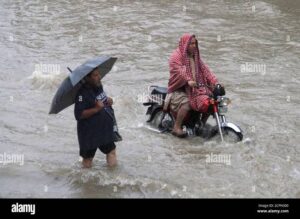
In recent years, Pakistan has faced a barrage of devastating floods, most notably in 2010 and 2022, displacing millions and causing billions in damages. The catastrophic scale of these disasters has led to a heated national and international debate: are these floods primarily a result of climate change, or do they reflect systemic corruption and mismanagement within Pakistan’s governance structures?
While climate change undoubtedly plays a role in intensifying weather patterns, many experts argue that the extent of devastation caused by floods in Pakistan is amplified by poor infrastructure, unplanned urbanization, deforestation, and institutional failure. This article explores both dimensions in detail to better understand whether the root cause of Pakistan’s flooding lies in global climate shifts or closer to home in flawed governance and corruption.
Section 1: Understanding the Scale of the Problem
1.1 A History of Floods in Pakistan
Pakistan has always been prone to flooding due to its geography and seasonal monsoons. The Indus River system, which nourishes much of Pakistan’s agricultural land, is also the source of its vulnerability. When monsoon rains intensify, rivers overflow, inundating vast tracts of land.
2010 Floods: Considered one of the worst natural disasters in Pakistan’s history, these floods affected over 20 million people, destroyed crops and infrastructure, and caused over $10 billion in damages.
2022 Floods: Triggered by erratic monsoon rains and melting glaciers, one-third of Pakistan was submerged. More than 1,700 lives were lost, and over 33 million people were affected.
These catastrophes are not isolated events but part of an escalating pattern.
Section 2: The Case for Climate Change
2.1 Global Warming’s Role
According to the Intergovernmental Panel on Climate Change (IPCC) and World Weather Attribution studies, rising global temperatures have made South Asia’s monsoon system more volatile. In Pakistan, average temperatures have increased by about 0.5°C since the 1960s, leading to more intense rainfall in shorter periods.
Glacial Melt: Pakistan is home to over 7,000 glaciers—the most outside the polar regions. Rising temperatures are accelerating glacial melting in the Hindu Kush-Himalaya region, increasing the risk of glacial lake outburst floods (GLOFs).
Sea Surface Temperatures: Warmer oceans contribute to heavier monsoons. Climate change models show that extreme monsoon events are becoming 100% more likely in South Asia due to climate change.
2.2 Unequal Impact of Emissions
Pakistan contributes less than 1% of global greenhouse gas emissions but is ranked among the top 10 most climate-vulnerable countries in the world. This raises ethical concerns about climate justice. The global North’s industrial emissions have led to global warming, while countries like Pakistan face the consequences.
Section 3: The Case for Corruption and Mismanagement
3.1 Poor Urban Planning and Encroachments
In cities like Karachi, Lahore, and Islamabad, unchecked urban expansion has encroached on natural waterways and drainage systems. Housing societies and illegal settlements are often built on flood plains, which should serve as natural buffers during heavy rains.
In the 2022 floods, urban flooding in Karachi was intensified by blocked drains and illegal construction over stormwater channels.
3.2 Deforestation and Land Misuse
Pakistan’s forest cover is among the lowest in the world—about 5% of the land area, well below the international recommended minimum of 25%. Trees absorb rainwater and stabilize soil. Widespread logging, land grabbing, and the conversion of forests into agricultural or commercial land have increased flood risks.
Despite government-led programs like Billion Tree Tsunami, enforcement remains weak, and deforestation continues, especially in Khyber Pakhtunkhwa and Punjab.
3.3 Corruption in Disaster Management
Corruption exacerbates the impact of climate disasters:
Funds allocated for flood defenses and drainage systems often disappear due to mismanagement.
Construction contracts for embankments and dams are frequently awarded to politically connected contractors who cut corners.
Relief efforts are uneven, with aid sometimes distributed based on ethnic, tribal, or political affiliations, rather than actual need.
A Transparency International report ranked Pakistan 133rd out of 180 countries in its 2022 Corruption Perceptions Index. The failure of institutions such as the National Disaster Management Authority (NDMA) to prepare for and respond efficiently to floods highlights how systemic corruption undermines climate resilience.
Section 4: When Climate Change Meets Corruption
In Pakistan, the impact of climate change is multiplied by corruption and poor governance. The science is clear: extreme weather events are becoming more frequent. However, their devastating outcomes are not inevitable.
4.1 Infrastructure That Fails
Even when early warnings are issued, lack of infrastructure—from flood barriers to emergency shelters—means millions remain vulnerable. In many areas, levees and embankments have not been maintained since their construction decades ago.
The 2022 floods revealed how neglected canals, silted rivers, and compromised irrigation networks fail to protect communities. Corrupt procurement processes and lack of accountability prevent durable solutions.
4.2 Inequity in Response and Recovery
Flood relief efforts are often politicized. In some provinces, aid was reportedly diverted or delayed based on party loyalties or sectarian affiliations. Donor agencies have repeatedly raised concerns about the lack of transparency in fund utilization.
This leads to donor fatigue, where international organizations hesitate to contribute, fearing their money will not reach the affected people.
Section 5: Media, Narrative, and Responsibility
5.1 Government Framing: “It’s All Climate Change”
Pakistani leaders, including the former Prime Minister Shehbaz Sharif, have frequently labeled floods as “climate-induced disasters”, seeking global sympathy and financial aid. While this framing is partially accurate, it can deflect attention from domestic failures.
The climate change narrative becomes a convenient scapegoat, allowing politicians to avoid accountability for poor planning, corruption, and negligence.
5.2 Civil Society and Whistleblowers
Activists and NGOs in Pakistan have pushed back against this narrative, highlighting local corruption, deforestation, and policy failures as key contributors to the flood crisis.
For example, urban planners in Lahore have raised alarms for years over construction in flood-prone areas like the Ravi River basin, but have been ignored or silenced.
Section 6: A Path Forward – Addressing Both Crises
To reduce flood vulnerability, Pakistan must address both climate adaptation and institutional reform.
6.1 Climate Adaptation Strategies
Invest in Climate-Resilient Infrastructure: Build and maintain levees, dams, and early-warning systems.
Sustainable Agriculture: Promote farming practices that reduce water use and improve soil retention.
Glacial Monitoring: Invest in satellite technology and local surveys to detect GLOFs early.
6.2 Governance and Anti-Corruption Measures
Decentralize Disaster Management: Empower local governments and communities to manage resources and respond faster.
Transparent Budgeting: Use blockchain or digital audits to track relief funds and infrastructure budgets.
Legal Reforms: Enforce strict penalties for illegal land use and encroachments.
6.3 Public Awareness and Education
Building public understanding of flood risks and preparedness is essential. This includes:
Educating schoolchildren about climate resilience.
Training communities in evacuation drills.
Encouraging responsible land-use practices.
Conclusion
Pakistan’s floods are a dual crisis: a natural calamity intensified by climate change and a man-made disaster fueled by corruption and mismanagement. Climate change is global, but the depth of devastation in Pakistan stems largely from local failures—of governance, accountability, and long-term planning.
Until both issues are addressed—internationally through climate finance and locally through structural reforms—floods will continue to ravage the country, displace millions, and hold back economic progress.
The lesson is clear: Pakistan cannot control the rain, but it can control how it prepares for it.
—

