

*Core Problem*
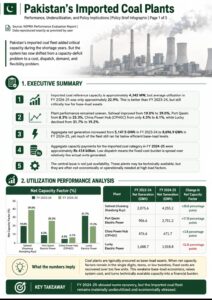
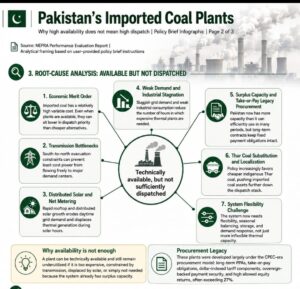
Built as base-load assets, the fleet operated at only ∼22.9% utilization in FY 2024-25. Consumers still bear massive capacity payments, dollar-indexed returns, and imported-fuel exposure.
*Plant-wise Utilization FY 2024-25*
– *Sahiwal*: 39.0%
– *Port Qasim*: 25.3%
– *Lucky Electric*: 19.2%
– *China Power Hub*: 6.1%
*Why they remain poorly dispatched*
– High imported coal costs
– Surplus generation capacity
– Weak electricity demand
– Transmission constraints
– Competition from cheaper Thar coal and distributed solar
Result: Pakistan is paying for expensive capacity that cannot be used efficiently.
—
### Key Issues
*1. Inflated Project Costs and Over-Invoicing*
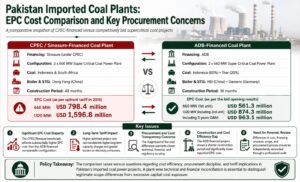
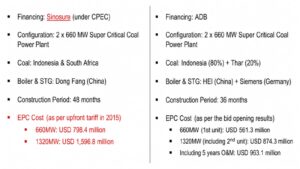
A comparison of 2 × 660 MW supercritical coal projects shows a major gap:
– *CPEC/Sinosure benchmark EPC cost*: US$1,596.8 million
– *ADB-financed competitive bid EPC cost*: US$874.3 million
– *ADB package with 5 years O&M*: US$963.1 million
The difference is a serious audit concern requiring technical and financial reconciliation.
*2. Long-Term Tariff Lock-In*
Any excessive project cost is embedded in the tariff base and affects:
a) Debt repayment
b) Return on equity
c) Insurance and financing charges
d) Dollar-indexed capacity payments
Consumers may keep paying returns on an overstated asset value for the entire PPA term, even during periods of very low generation.
*3. Underutilized Base-Load Capacity*
The imported-coal fleet averaged ∼22.9% utilization in FY 2024-25 while receiving ~Rs 414 billion in capacity payments.
Fixed payments recovered over limited generation raise the effective cost per unit and worsen tariff pressure and circular debt.
*4. Coal-Procurement Governance Weaknesses*
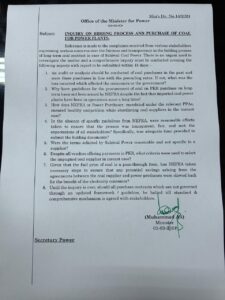
The Minister for Power’s inquiry dated 1 March 2024 flagged serious concerns on Sahiwal Power’s long-term coal-procurement process. No report has been issued to date.
*5. Weak Cost Discovery and Risk Allocation*
These plants helped end load-shedding when shortages were severe. The current burden comes from the procurement structure:
a) Weak competitive cost discovery
b) High approved project costs
c) Dollar-indexed returns
d) Sovereign-backed payment obligations
e) Take-or-pay capacity contracts
f) Misalignment of generation, transmission, and demand.
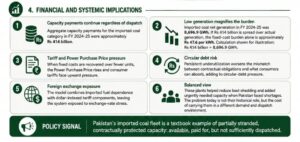
Pakistan solved the capacity shortage but created a long-term affordability and dispatch challenge.
—
### Required Policy Response
*a. Project-Cost Verification*
Reconcile EPC costs, equipment specs, civil works, environmental systems, taxes, logistics, and associated infrastructure against comparable international projects.
*b. Related-Party Transaction Review*
Examine links between sponsors, EPC contractors, equipment manufacturers, service providers, and coal suppliers.
*c. Coal-Procurement Audit*
Review tender design, supplier qualification, bid evaluation, coal prices, freight, quality specs, handling charges, and pass-through treatment.
*d. Tariff-Base Correction*
Identify unsupported or excessive costs still earning debt recovery or equity returns. Pursue correction through legal and regulatory channels.
*e. Contract Restructuring*
Seek: lower returns, debt reprofiling, longer repayment periods, reserve-role arrangements, or shift from take-or-pay to take-and-pay where legally and diplomatically feasible.

Asim Riaz :
The author is Energy Advisor
MPhil Strategic Studies, NDU, Islamabad
Masters Energy Management
Graduate Mechanical Engineering, UET, Taxila

