

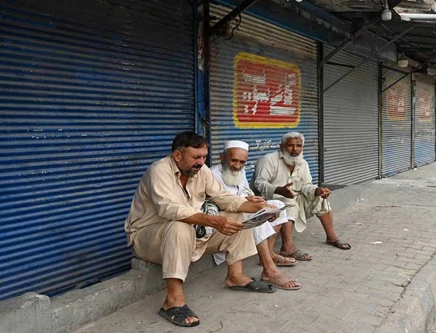
Nearly 70 million Pakistanis now live below the national poverty line. Against the World Bank’s $4.20 a day poverty line for lower middle income countries, the figure is around 120 million people. Real household incomes have fallen by 12 percent in six years. Officially, 5.9 million people are unemployed. On Dr Hafiz A. Pasha’s estimate of 22 percent, the number could be closer to 18 million. Inequality has widened, and nearly four in ten children are stunted.
The state’s own numbers now admit the scale of the problem. The Pakistan Economic Survey puts national poverty at 28.9 percent in 2024/25, up from 21.9 percent in 2018/19. That means nearly 70 million people are living below the national poverty line, with millions pushed into poverty over just six years.
Rural poverty has risen from 28.2 to 36.2 percent. Urban poverty has climbed from 11 to 17.4 percent. Inequality has also increased, with the Gini coefficient rising from 28.4 to 32.7, according to the figures cited in the poverty assessment.
What does it mean to be one of those 70 million? The national poverty line is approximately Rs8,484 per adult per month, or around Rs280 a day. That is not money for food alone. It has to cover rent, electricity, gas, the bus fare to work, school expenses and medicine. Millions of Pakistanis cannot afford even this basic standard of living.
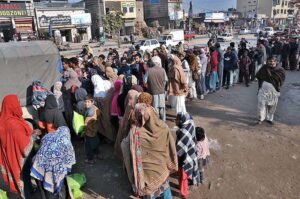
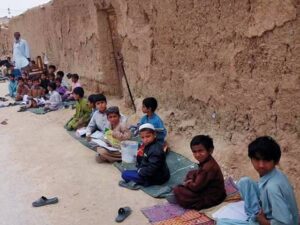
So they cut back. Meals shrink to roti and tea, and sometimes to roti alone. Milk, eggs, meat and fruit disappear from the table. Children leave school for workshops, fields and domestic work. Illness is ignored until it becomes an emergency. Families borrow from shopkeepers or landlords, sell livestock, or part with the gold saved for a daughter’s wedding.
Each of these choices buys survival today at the cost of tomorrow. That is how poverty in Pakistan passes from parents to children. It is the one inheritance the poor are almost certain to leave.
Yet only months earlier, we were told that poverty was falling. In October 2025, the World Bank estimated that poverty under its international $4.20 a day measure had declined to 45 percent in FY2024/25. Those estimates were based on older household consumption data and modelling, not the latest completed household survey. When the new survey results became available, Pakistan’s national poverty rate stood at 28.9 percent.
The two figures use different poverty lines and cannot be compared directly. But the larger lesson remains important. Economic policy was being assessed without a sufficiently current picture of how ordinary households were actually living.
Measured internationally, the picture is also deeply troubling. The World Bank’s $4.20 a day threshold is designed for cross country comparisons and is higher than Pakistan’s national poverty line. Against that threshold, the estimated share of Pakistanis living in poverty was 47.9 percent in 2024/25, or roughly 120 million people, according to the figures cited in this assessment.
The World Bank’s March 2026 update also revised its estimate of extreme poverty in the Middle East, North Africa, Afghanistan and Pakistan region from 11.8 to 14.4 percent for 2024, adding approximately 21 million people to the regional count. The revision was driven primarily by new Pakistani survey data.
Pakistan must stop treating poverty as something to be managed through cash transfers and press conferences. It is a failure of economic opportunity, public services and governance. That failure has consequences for every part of our national future.
Stabilisation Is Not Recovery
Between 2001 and 2018/19, poverty fell from 64.3 to 21.9 percent. That progress was real. But it rested heavily on low productivity work and a shift towards informal services that did not provide secure, well paid employment. The World Bank has warned that this model has reached its limits.
When COVID, the 2022 floods, record inflation and repeated currency depreciation arrived, millions of families had little protection against the shock. They had escaped poverty on paper, but many had not built the savings, skills or secure incomes needed to stay out of it.
We measure recovery in foreign exchange reserves, fiscal surpluses and successful IMF reviews. A national balance sheet can improve while household finances deteriorate. That is the central problem with the way we judge economic progress.
The Planning Ministry’s figures show real monthly household income falling from Rs35,454 to Rs31,127. If measured on a comparable price adjusted basis, this represents a substantial loss of purchasing power. For a family already spending most of its income on food, transport and utilities, that loss is not an accounting entry. It means less food, delayed medical treatment and children whose education becomes unaffordable.
The Planning Minister has himself acknowledged that economic stabilisation under the IMF programme contributed to the increase in poverty. Stabilisation was necessary to address Pakistan’s economic imbalances. But it cannot be considered a success if the burden falls disproportionately on households that have the least capacity to absorb it.
Then there are the jobs that never came.
Officially, unemployment stands at 7.1 percent, its highest level in 21 years, representing around 5.9 million people. Dr Hafiz A. Pasha, a former finance minister, has estimated the real rate at about 22 percent using his analysis of the 2023 census. With a labour force of approximately 83 million, that would imply close to 18 million people without work.
The Planning Ministry disputes this estimate, and census based calculations are not directly comparable with a standard labour force survey. The disagreement itself points to a serious problem. Pakistan needs reliable and timely employment data, particularly for young people and those who have stopped actively looking for work.
Every year, around 3.5 million young people join the labour force. The World Bank has estimated that one in six new entrants found no work at all. These are not merely statistics. They represent graduates returning to their parents’ homes, young people accepting work below their qualifications, and families spending their savings to support adults who should by now be earning.
And someone had to pay for stability.
Every time electricity bills rise, petrol becomes more expensive or sales taxes increase the price of essential goods, poorer households surrender a larger share of their limited income. The World Bank has described Pakistan’s reliance on indirect taxation as regressive. The salaried employee pays tax before the salary reaches the bank account. A low income household pays tax every time it buys fuel, electricity or other taxable goods.
Agricultural taxation illustrates the imbalance. In 2025/26, approximately 445,000 taxpayers reportedly declared Rs306 billion in agricultural income, while the four provinces provisionally collected around Rs5.6 billion in tax on that income. These figures point to a substantial gap between declared agricultural income and tax collected, although the collection ratio should not be confused with the effective tax rate on all agricultural income.
A country cannot tax its way to prosperity by squeezing the people least able to pay. Nor can it build a fair tax system while leaving substantial sources of income and wealth inadequately documented and taxed.
We Are Failing Our Children
Nearly 40 percent of children under five are stunted. Stunting is not simply being short. It means a child’s body and brain have not received the nutrition needed for proper development during the earliest years of life. The consequences can last a lifetime.
Around one quarter of primary school aged children are out of school. Among those who attend, learning outcomes remain deeply worrying. World Bank estimates have previously indicated that roughly three in four Pakistani children of late primary school age could not read and understand a simple text at the expected level.
Each of these children is a future worker, parent and voter. A child who is malnourished and cannot read at ten will struggle to earn a decent living at twenty five. The damage extends beyond the individual. It reduces national productivity, limits economic growth and perpetuates poverty across generations.
The Economic Survey cites an increase in school attendance from 61 to 67 percent as progress. That is welcome, but attendance is only the first step. A child sitting in a classroom is not necessarily learning. We must judge schools by whether children can read, write and perform basic mathematics, not simply by enrolment figures or buildings constructed.
Nutrition, healthcare and education are economic investments. A country that neglects them today will pay a much higher price in lost productivity and social protection tomorrow.
The Provinces Cannot Hide
Since the Eighteenth Amendment, education, health, agriculture and much of local development have been provincial responsibilities, supported by substantial transfers through the National Finance Commission award.
Yet every province has seen poverty increase. Punjab’s poverty rate rose from 16.5 to 23.3 percent. Sindh’s increased from 24.5 to 32.6 percent. Khyber Pakhtunkhwa rose from 28.7 to 35.3 percent, while Balochistan increased from 41.8 to 47 percent.
Inflation, currency depreciation, floods and economic instability cannot be blamed entirely on provincial governments. Much of the pressure originated at the national level. But the provinces control many of the services that determine whether a poor family can improve its circumstances.
They must therefore answer for the quality of public schools, basic healthcare, nutrition programmes, agricultural extension and local services. Too much attention is given to visible development schemes and announcements, while the less glamorous work of improving institutions and service delivery remains neglected.
A new road or a grand project may have its place. But a functioning school, a staffed rural health centre and reliable access to clean water can have a much greater impact on a poor household’s long term prospects.
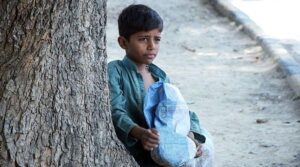
The test of provincial performance should be whether children are learning, preventable illnesses are declining, farmers are earning more and families are moving out of poverty.
What Pakistan Needs to Do Now
First, make job creation the central test of economic policy. Every major decision should be judged by its effect on employment, wages and household incomes. This applies to taxation, energy prices, industrial policy, agriculture and investment incentives.
Pakistan needs more productive jobs in manufacturing, information technology, construction, tourism and export oriented services. In rural areas, small farmers need better seeds, reliable water, storage, credit and access to markets. Predictable taxes and reliable electricity will do more for sustainable employment than repeated incentive packages that favour a narrow group of investors.
Second, invest in children before it is too late. Every district should have published targets for child nutrition, school attendance and foundational learning. These targets should be independently verified, and budgets should increasingly reflect results rather than spending alone. Nutrition support for pregnant women, infants and young children must become a priority, particularly in the poorest districts.
Third, turn social protection into a route out of poverty, not simply a means of surviving it. The Benazir Income Support Programme must be protected against inflation so that its benefits retain their purchasing power. But cash assistance should also connect families with skills training, childcare, healthcare, financial services and employment opportunities.
A mother receiving social assistance should have a realistic opportunity to enter paid work if she chooses to do so. A young person from a poor household should have access to training linked to actual vacancies, not merely receive a certificate at the end of a government programme.
Fourth, change who pays tax. All provinces have now legislated agricultural income tax reforms. The next step is effective implementation through better land records, stronger assessment systems and appropriate data sharing with the Federal Board of Revenue. Property taxation must reflect more realistic valuations, while retail activity should be documented more effectively.
The objective should not simply be to collect more revenue. It should be to broaden the tax base, reduce excessive reliance on indirect taxation and ease the burden on low and middle income households. Those with greater capacity to pay must contribute a fairer share.
A Five Year Poverty Compact
The federal and provincial governments should agree on a five year poverty compact with annual targets for poverty reduction, real household incomes, job creation, child nutrition and learning outcomes.
These targets should be published district by district, allowing citizens to see whether their circumstances are improving and whether public money is producing results. The Pakistan Bureau of Statistics should conduct household surveys regularly so that national policy is not once again built on six years of uncertainty.
The compact should identify which level of government is responsible for each target, how much funding is required and how progress will be independently measured. Programmes that repeatedly fail to deliver should be redesigned or closed, regardless of who introduced them.
Parliament and the provincial assemblies should review progress annually. Poverty reduction should become a measurable responsibility of government rather than a promise repeated in every budget speech.
The Real Test
The government must pursue economic stability. Pakistan cannot build lasting prosperity on uncontrolled deficits, unsustainable borrowing or persistent inflation. But stability should be the beginning of recovery, not its definition.
The test is simple. Can a working family afford nutritious food without taking its children out of school? Can a young person find a decent job without knowing the right people? Can a small farmer earn a fair return? Can a woman work without facing barriers at every step? Can a family survive an illness or a lost job without losing everything it has built?
Until Pakistan can answer these questions with measurable progress, any talk of recovery is premature.
The man on the building site will know the economy has recovered when his son is back in school.
Poverty is not reduced when governments announce that the economy is improving. It is reduced when ordinary people can see and feel that improvement in their own lives.
That is the standard by which Pakistan’s economic policy must now be judged.

Fazeel Asif
The author is a policy analyst and former Chairman of the Punjab Board of Investment and Trade. He can be reached out at : [email protected]

