

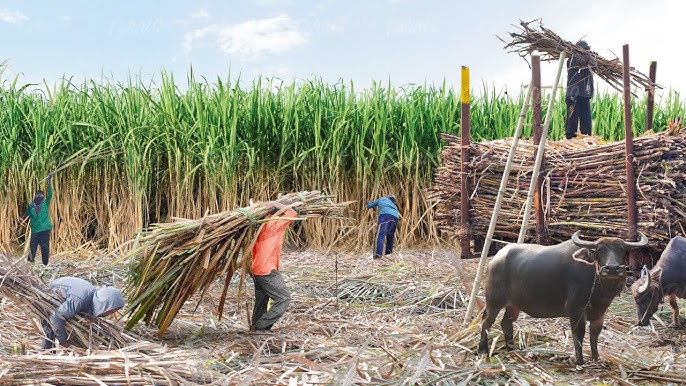
Sugarcane is a tropical crop. It evolved in wet climates, the kind found in Brazil’s center-south, coastal India, and Thailand’s humid plains, places where water arrives from the sky in abundance and the soil stays saturated for months. In those landscapes, you don’t coax the crop into existence. It simply belongs.
Stand in a Brazilian cane field after summer rains, and you understand: this plant is home. Now stand in a Pakistani cane field, in Rahim Yar Khan or Sahiwal, in April, when the dust hangs in the air and the canals are running low. The green stands out against the brown, but it is not a natural green. It is an engineered one, sustained by tubewells that draw fossil water from depths that will not recharge in our lifetimes, by canals that divert Indus flows across hundreds of kilometers, by a political system that has spent three decades making this crop irresistible while the logic of the land says it should not be here.
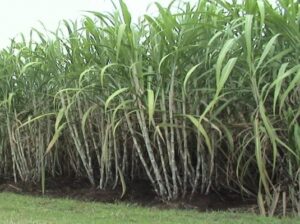
Pakistan is semi-arid. Per capita water availability has fallen from over 5,000 cubic meters in the 1950s to around 900-1,000 cubic meters today, below the international water scarcity threshold. The Indus basin is one of the most heavily extracted river systems on earth. And yet we devote roughly three million acres, an area the size of Lebanon, to one of the most water-intensive crops in agriculture. Under Pakistani conditions, sugarcane consumes an estimated 18,000-25,000 cubic meters of water per hectare.
This did not happen because of geography. It happened because of politics.
How We Got Here
Thirty years ago, sugarcane occupied a much smaller footprint in Pakistan’s cropping calendar. In the early 1990s, total area under cane was under 900,000 hectares nationwide. By 2010-11, it had grown to 988,000 hectares. By 2022-23, it had reached 1.32 million hectares, roughly 3.26 million acres, and it has continued climbing since.
The expansion was not gradual or organic. It followed the installation of sugar mills, pushed into regions that were not historically cane country. Rahim Yar Khan, one of Punjab’s core cotton districts, saw sugarcane area increase by over 600 percent between 1990 and 2023. That district now hosts six sugar mills. The mills did not follow farmers. The farmers followed the mills, because the mills brought guaranteed procurement and government-backed minimum support prices that increased threefold over a decade.
Cotton bore most of the cost. Cotton area stood at around 3.1 million hectares in 2000. Today it sits at 1.7-2.0 million hectares. Production has fallen from 13-14 million bales a season, reaching a low of around 4.5-5.0 million bales before partial recovery pushed output closer to 8-10 million bales, still short of domestic demand. Pakistan’s textile mills, which employ ten million people and account for over half the country’s foreign exchange earnings, now import 4-6 million bales of raw cotton annually to stay operational, at a cost of 2.5-3 billion dollars a year.
We expanded a water-intensive tropical crop in a semi-arid country, and the direct consequence was that we had to start importing the water-efficient, export-generating crop it displaced. As cane spread through the irrigated belts, it also crowded out oilseeds and pulses, crops that require far less water and would have reduced the import burden that now bleeds the current account. Pakistan’s edible oil bill runs to 3-4 billion dollars annually. Pulses imports add another 1-2 billion dollars. These are not supply failures rooted in poor agronomics. They are the downstream consequences of a cropping pattern shaped by political incentives rather than resource logic.
Farmers are not irrational. They respond to signals. For thirty years, the signals said: grow cane
The Farmer Is Not the Winner
The standard defense of the sugar regime is that it protects farmers. It is worth asking: protects them from what, and at whose expense?
Consider a small farmer in southern Punjab. He plants cane because the mill contract offers something no other crop does: a guaranteed buyer. But that guarantee comes with a four-to-six-month payment delay. He cannot wait that long. His children need school fees. His input supplier needs payment. His family needs to eat. So he borrows from the local aarthi, the commission agent, at 3 to 5 percent per month, simply to survive between harvest and payment.
The mill captures liquidity. The farmer captures debt. The political owner captures influence.
This is not incidental to how the system works; it is the point. Sugar mill ownership in Pakistan overlaps heavily with political office. Agricultural policy becomes the instrument through which mill owners convert economic position into political power, and political power back into economic advantage. That cycle buys continued favorable water pricing, continued protectionist import policies, continued access to subsidized credit. It is rent-seeking with a flag of farmer protection flying over it.

The farmer is not choosing sugarcane because it is profitable. He is choosing it because, in a system captured by mill owners, it is the only crop that offers any guarantee at all. The choice is between a bad deal and no deal. That is not protection. That is entrapment.
The Water Transfer Nobody Talks About
Sugarcane consumes an estimated 15 percent of canal withdrawals from the Indus system every year. That water is priced at a fraction of its economic value through flat irrigation rates that bear no relationship to scarcity. Farmers pay a fixed fee per acre, regardless of how much water they use or how valuable its alternative applications might be.
The result is an implicit transfer: hundreds of millions of dollars’ worth of underpriced water allocated annually to sustain a crop that would be far less attractive if it had to pay a realistic price for what it consumes.
Call it what it is: not agricultural policy, but rent allocation.
Other water-scarce countries have faced this choice differently. Australia’s Murray-Darling Basin, confronting similar challenges, implemented water trading and government buybacks to shift water from low-value uses to higher-value ones and environmental flows. Farmers were compensated. The system adjusted. The key was political will to price water realistically. In Pakistan, we have created an economic fiction, water priced as though it were infinite, and we are paying for it with depleted aquifers that will not recover on any political timeline.
The Damage That Doesn’t Reset
The cost doesn’t end at canal withdrawals. In Punjab, crop residue burning after cane harvest adds to winter particulate pollution in a region already struggling with seasonal smog. In cane belts where canal supply is unreliable, farmers fill the gap with tubewells, quietly transferring the depletion from surface systems to groundwater, where it is invisible until it is catastrophic. We are spending water capital that cannot be replenished to maintain a political equilibrium that benefits a few hundred families.
What makes this harder to justify is that we are not even doing it efficiently. Pakistan’s average sugar recovery rate, the percentage of sugar extracted from cane, typically sits around 9.5-11 percent. Brazil routinely exceeds 12.5-14 percent, through better varieties, tighter logistics, and more capable mills. We extract less sugar from each tonne of cane while using more water per hectare to grow it. If a country insists on cultivating a water-intensive crop against its own climate, the minimum expectation is world-class efficiency. We have neither the climate advantage nor the productivity advantage.
Pakistan is not alone in this trap. India’s Punjab ran the same political loop, minimum support prices, subsidized electricity for tubewells, free water, and its water table is now falling by half a meter or more per year in parts of the state. The destination of that road is visible. We are still choosing to take it.
What a Rational System Would Look Like
None of this requires eliminating sugarcane. It requires rationalizing it.
A gradual reduction to around 1.1-1.2 million acres, spread over several seasons, with land and water redirected toward oilseeds, pulses, cotton, and higher-value horticulture, would reduce edible oil imports, stabilize cotton supply for the textile sector, and improve income diversity for farmers who currently have very little of it. To put this in perspective, it would restore cane to below its early-1990s footprint before the mill-driven expansion reshaped the cropping pattern. A remaining base concentrated in the most suitable zones and paired with serious investment in recovery rates could meet most domestic demand. Importing a marginal shortfall would cost less than the ecological distortion we are currently running.
But reform doesn’t have to be confrontational. It has to be economic.
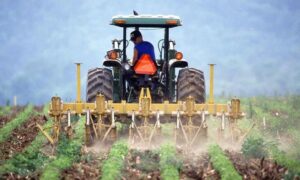
Tiered irrigation pricing, where water-intensive crops pay progressively higher rates and alternatives like oilseeds or pulses pay lower ones, shifts incentives without banning anything. Direct input support and yield-linked payments for alternative crops build a counter-constituency among farmers who would benefit from diversifying. Digital payment systems reduce the leverage that mill-controlled credit channels currently hold over smallholders.
Crucially, any reform body, a water regulatory authority, a crop diversification board, must be independent of the sugar mill ownership network. If the people setting water prices or support levels are the same people who own the mills, reform is impossible. Independent institutions, transparent data, rules that apply equally: these are not luxuries. They are the minimum conditions for rational policy.
Stop making cane artificially irresistible. Farmers respond to price signals. Give them honest ones, and the system will move on its own.
Why It Hasn’t Changed
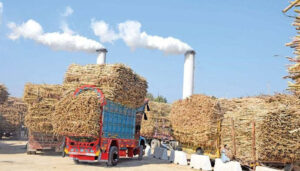
Sugar mill owners are not just industrialists. Many hold legislative office. They influence irrigation allocation, rural credit, and district-level administration. Reform threatens a concentrated rent base, which is why it stalls every time it gets close.
But the costs of inaction are compounding. Every year of delay means another year of groundwater depletion that cannot be undone. Another year of cotton farmers switching to cane, only to discover that the promised returns arrive months late, if at all. Another year of textile mills importing raw cotton that could have been grown here. Another year of edible oil imports bleeding foreign exchange. Another year of smog.
The deeper issue is not technical. It is between a system that allocates resources rationally and one that allocates them politically. Between water priced at its value and water priced at zero. Between farmers who have genuine options and farmers who are trapped.
The Real Choice
Every country’s agriculture reflects choices about who gets what and at whose expense. Brazil grows sugarcane because rainfall supports it. Jordan pulled back from water-intensive agriculture because scarcity forced realism. Chile moved its irrigated valleys toward export horticulture because the economics, not a government decree, made it the rational choice. Pakistan continues expanding a tropical crop in a semi-arid country and treats the consequences, the smog, the depleted aquifers, the collapsing cotton sector, the import bills, as if they were acts of nature.
They are not. They are the predictable outcomes of a policy structure designed to protect concentrated interests while distributing costs across everyone else.
We are not short of land. We are not short of farmers. We are not short of alternatives. We are short of water, and we are still pricing it as though it were infinite.
That is not an agricultural mistake. It is a structural choice.
Brazil’s cane fields are a map of its rainfall. Pakistan’s are a map of its power structure. The question is not whether we can afford to change the map. The question is whether those who drew it will allow us to.
Structural choices can be changed. But only if we stop pretending they are something else.

Fazeel Asif
The author is a former advisor to public and private sector . He carries 30 years experience for corporate sector. He can be reached out at :
[email protected]

