

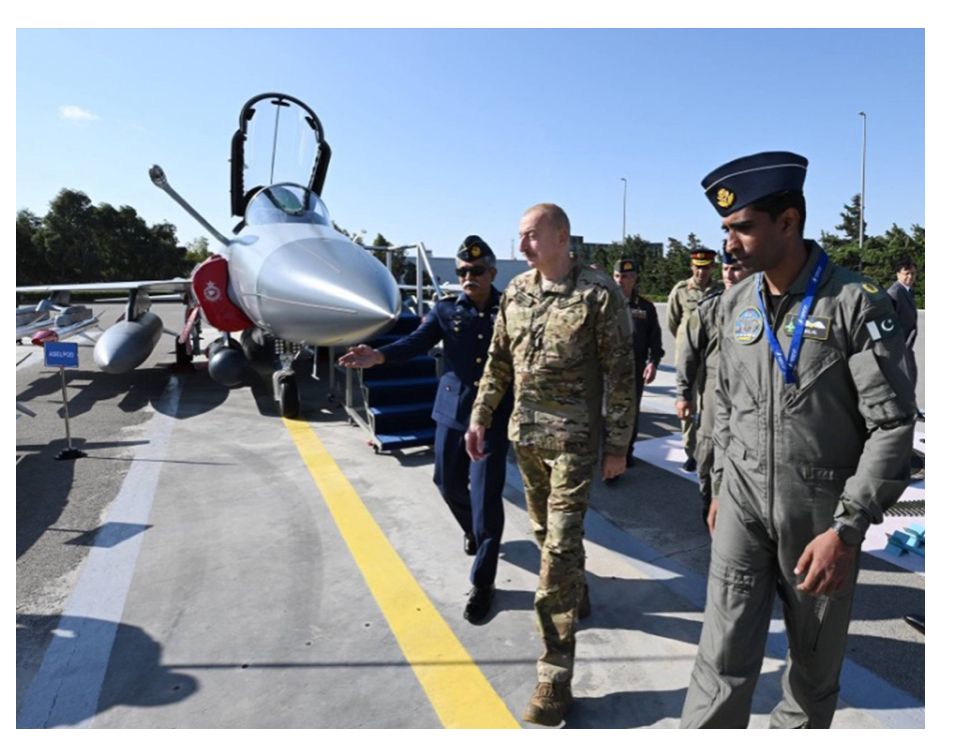
Azerbaijan’s acquisition of Pakistan’s latest-generation JF-17C Block III “Thunder fighter jets marks a historic leap in the balance of airpower across the South Caucasus. The induction strengthens the Ankara-Islamabad-Baku defence axis, elevates Pakistan’s status as an emerging aerospace exporter, and compels Armenia to urgently seek counter-capabilities in a rapidly shifting regional arms race.
Baku has reportedly received its first batch of JF-17C Block III aircraft from Pakistan under a $4.6 billion defence partnershipthe largest in Pakistan’s defence export history. Three aircraft, including two single-seat fighters and one dual-seat trainer, have been spotted at Nasosnaya Airbase north of Baku, signaling the start of deliveries.
The arrival of these 4.5-generation fighters underscores Azerbaijan’s determination to modernize its air force and move beyond reliance on legacy Russian systems such as the MiG-29 Fulcrum and Su-25 Frogfoot. The upgraded Nasosnaya Airbasefeaturing extended runways, hardened shelters, and new hangarsnow serves as the operational hub for the Thunder fleet.
Pakistan entered the realm of 4.5-generation warfare through the co-development of the JF-17 program with China’s Chengdu Aircraft Corporation (CAC). This collaboration evolved into one of the most consequential joint fighter projects of the 21st century, undertaken by the Pakistan Aeronautical Complex (PAC). The Block III variant marks a significant technological advancement, incorporating:
AESA radar (KLJ-7A) for superior target tracking
Digital fly-by-wire controls and a wide-area cockpit display
Helmet-mounted sight and cueing systems
Network-centric data-link capabilities
The Block III’s defining feature is its integration of the PL-15 long-range air-to-air missile, boasting a range exceeding 150 km and rivaling Western counterparts such as the AIM-120D and Meteor. Combined with the AESA radar and advanced electronic countermeasures, the JF-17C enables simultaneous multi-target engagementgranting Azerbaijan a decisive edge in beyond-visual-range (BVR) combat.
Beyond air superiority, the Thunder’s seven hardpoints support a wide array of weapons, including precision-guided munitions, laser-guided bombs, and the Chinese C-802AK anti-ship missile, enabling deep strike and maritime interdiction missions. Powered by the Russian RD-93 turbofan engine, the aircraft can reach Mach 1.6 (1,910 km/h) and operate over a 3,400 km range with external fuel tanks.
Armenia has reacted with alarm to Azerbaijan’s induction of the JF-17C, viewing it as a direct threat to its air deterrence balance. In response, Yerevan is expected to accelerate procurement of advanced air-defence and combat systemspotentially turning to Russia for MiG-35 or Su-30SM2 fighters and modern SAM systems.
Analysts suggest Armenia may also seek radar and missile cooperation with India or France to reinforce its airspace defences. However, the PL-15’s long-range reach means Armenia must urgently upgrade its early-warning networks or risk ceding aerial dominance to Baku in any future conflict.
Launched in the late 1990s, the JF-17 program was conceived as an affordable, high-performance fighter for developing nations. Its evolution through three successive blocks mirrors Pakistan’s growing aerospace maturity:
Block I: Baseline multirole variant
Block II: Added aerial refuelling, data link, and EW upgrades
Block III: Full 4.5-generation capabilities
For Pakistan, the Azerbaijan contract symbolizes the culmination of two decades of indigenous defence innovation. The deal not only validates Pakistan’s ability to design, manufacture, and export advanced combat aircraft but also positions it as a serious competitor to legacy Western manufacturers such as Dassault, Saab, and Lockheed Martin.
The fighter deal originated in 2024 under the deepening trilateral defence alignment between Pakistan, Turkey, and Azerbaijan. Initially valued at $1.6 billion for 16 aircraft, the agreement expanded into a $4.6 billion package covering up to 40 jets, weapons, training, and logistical support.
Crucially, the deal integrates Turkish electronic warfare suites and communication systems into the JF-17C fleet, reinforcing operational interoperability under the “Two States, One Nation doctrine. This enhances joint operations between Turkish and Azerbaijani forcesmirroring NATO-level tactical integration.
Beyond geopolitics, the financial implications of the deal are significant. At an estimated $25–30 million per unit, the JF-17C delivers 4.5-generation performance at a fraction of the cost of Western fighters such as the Rafale F4 ($115 million) or F-16V ($70 million).
For Islamabad, this contract represents not just an export milestone but a lifeline for Pakistan’s defence industry, bringing valuable foreign currency inflows and global recognition. The success has already sparked interest from potential buyers including Iraq, Egypt, and Malaysia, each seeking cost-effective modernisation options
The JF-17C is not merely an aircraftit anchors a broader networked air combat ecosystem. Equipped with data-link connectivity, it can operate in tandem with Azerbaijan’s drone fleet, creating a manned-unmanned teaming environment that enhances real-time situational awareness and strike coordination.
This hybrid doctrine, already adopted by advanced air forces such as those of Turkey and the United States, positions Azerbaijan at the forefront of regional air warfare modernisation.
Azerbaijan’s pivot toward Pakistan and China marks a strategic decoupling from Moscow’s military orbit. With Russia’s defence industry constrained by sanctions and commitments in Ukraine, Baku’s diversification reflects a pragmatic shift toward partners offering cutting-edge technology without political strings.
The growing AnkaraIslamabadBaku nexus challenges both Russian and Iranian influence in the Caspian and South Caucasus regions, where the trio’s cooperation increasingly extends into energy, security, and defence production.
For Pakistan, the JF-17C export to Azerbaijan is more than a commercial successit is a geopolitical statement. The Thunder’s induction abroad validates Pakistan’s aerospace capabilities and underscores the country’s emergence as a credible player in the global defence market.
It also reinforces Pakistan’s broader strategic alignment with Turkey and Azerbaijan, encompassing naval, UAV, and missile cooperation. Together, these partnerships are redefining defence collaboration across the Muslim world.
Thunder Over the Caucasus
As the JF-17C Thunder takes to the skies of Azerbaijan, the balance of airpower in the South Caucasus tilts decisively in Baku’s favor. The deal not only strengthens Azerbaijan’s deterrent capability but also propels Pakistan into the ranks of global arms exporters.
Born of Sino-Pakistani engineering, refined by Turkish integration, and fielded by Azerbaijan’s pilots, the JF-17C represents the convergence of technology, strategy, and shared ambition. In an era where regional influence increasingly depends on the mastery of the skies, Azerbaijan’s Thunder fleet may prove to be the most consequential addition to its arsenal in a generationand the clearest signal yet that Pakistan’s aerospace ambitions have truly taken flight.
 Yousuf Khan
The writer is defense analyst for Middle East and South East Asia

