

KARACHI/QUETTA: Dr Mannoor Nasir, the female doctor who was targeted in an acid attack in Quetta, is currently receiving treatment at Aga Khan University Hospital (AKUH) in Karachi, where she underwent a comprehensive medical examination on Sunday.
Providing an update on her condition, Dr Rafi, a physician at AKUH Karachi, stated in a social media post that Dr Mannoor is now out of danger.
“Alhamdulillah, Dr Mannoor Nasir is out of danger. Doctors at AKU Karachi confirm that her life, vital organs and eyesight are safe. She suffered around 13 percent burn injuries and is receiving specialised care. Prayers for her full recovery. The culprits must not go unanswered; justice is needed,” he wrote.
The attack has triggered widespread condemnation across Pakistan, particularly within the medical community, where doctors and healthcare workers have expressed outrage over what
they describe as a growing failure to ensure the safety of healthcare professionals.
According to reports, Dr Mannoor was attacked with acid by unidentified assailants in Quetta, leaving her with burn injuries. Following initial treatment in Quetta, she was shifted to Karachi for specialised medical care. Authorities have launched ainvestigation into the incident, though no major breakthrough has yet been publicly announced.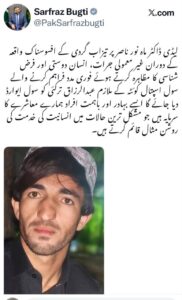
The attack has also sparked protests by young doctors in Balochistan, who have linked the incident to broader concerns about the security and working conditions of healthcare professionals in the province. Demonstrations have been held at several medical facilities, with doctors demanding immediate action against those responsible for the attack and stronger measures to protect medical staff. Young doctors argue that healthcare workers are routinely expected to perform their duties in challenging environments without adequate security arrangements. They complain that hospitals often lack basic safety infrastructure, including surveillance systems, controlled entry points and trained security personnel, leaving doctors vulnerable to violence and harassment.
The protesting doctors have also highlighted what they describe as insufficient facilities in public
hospitals. They maintain that healthcare professionals are already working under pressure due to limited resources, staff shortages and inadequate infrastructure, and that security concerns further worsen the situation.
As part of their protest campaign, young doctors have announced a boycott of certain services and warned that the movement could expand if authorities fail to address their demands. They
insist that the attack on Dr Mannoor should serve as a wake-up call for policymakers and health
authorities to prioritise the safety and welfare of medical professionals.
The incident has reignited concerns about acid violence in Pakistan, where rights groups have long called for stricter regulation of corrosive substances. Activists argue that despite existing laws against acid attacks, the easy availability of acid continues to pose a serious risk and enables perpetrators to commit such crimes.
Human rights advocates have urged the government to introduce stronger mechanisms for monitoring the sale, purchase and distribution of acid. They recommend licensing requirements
for vendors, stricter record-keeping procedures and harsher penalties for illegal sales.
Experts note that acid attacks are among the most devastating forms of violence, often resulting in severe physical injuries, emotional trauma and long-term social and economic challenges for
survivors. Recovery frequently requires extensive medical treatment.
Women’s rights organisations have also called for swift justice in the case, arguing that delays in investigations and prosecutions can undermine public confidence in the legal system. They stress that holding perpetrators accountable is essential not only for the victim and her family but also
for deterring similar attacks in the future.The attack on Dr Mannoor has generated significant attention on social media, where doctors, civil society activists and members of the public have expressed solidarity with the injured physician and demanded accountability. Many have also used the incident to draw attention to the broader issue of workplace safety for healthcare professionals.
For many doctors, the incident is not merely an isolated criminal act but a reflection of deeper systemic challenges that require urgent attention. They argue that without meaningful reforms,
including improved hospital security and stricter regulation of acid sales, healthcare workers will remain vulnerable while carrying out their professional responsibilities.
The coming days are expected to be crucial both for the investigation into the attack and for the ongoing protests by young doctors, whose demands have placed the spotlight on longstanding
concerns regarding safety, resources and working conditions within Pakistan’s healthcare system

