

The 18th Amendment was sold to Pakistan as the great democratic correction. A constitutional settlement, we were told, that would tame the overbearing centre, empower the provinces and bring government closer to the people. Sixteen years on, it has produced something far uglier. The federation is fiscally crippled, the provinces are politically entitled and administratively timid, and the citizens in whose name devolution was sanctified are worse off on nearly every measure that matters.
The grievance that drove the 2010 settlement was real. For decades, the federation in Islamabad had treated the provinces as administrative branches rather than constitutional partners, and the smaller provinces in particular bore the cost of that arrogance. The amendment was right to address it. But it was passed in the architecture of constitutional politics and never built out into the architecture of public service delivery. Pakistan transferred functions, money and constitutional prestige to the provinces without transferring any serious accountability, any real delivery capacity or any political incentive to perform. What emerged was not devolution to citizens. It was insulation for provincial elites.
The fiscal wreckage is plain enough.
 In FY26, debt servicing will consume Rs 8.2 trillion, which is 46.7 percent of the federal budget of Rs 17.57 trillion. In FY25, debt servicing absorbed 89 percent of net federal revenues, leaving scraps for defence, pensions, development, subsidies and the basic machinery of the state. Public debt has climbed from roughly 60 percent of GDP at the time of the 18th Amendment to 71 percent today, breaching the legal ceiling under the Fiscal Responsibility and Debt Limitation Act. External public debt has exploded from Rs 6 trillion in 2016 to Rs 26 trillion in 2025. Domestic debt has risen from Rs 13.6 trillion to Rs 54.5 trillion over the same window.
And what have the provinces done with the autonomy they fought for? They have hoarded cash and handed it back to the centre so Islamabad can satisfy the IMF. In the first half of FY26 alone, the four provinces transferred Rs 1.18 trillion in cash surplus to the federation under programme conditions. By the third quarter, the cumulative provincial surplus had reached roughly Rs 1.6 trillion. So much for devolution. What Pakistan now has is a perverse arrangement in which the centre borrows, the provinces sit on transfers, and development spending is choked so the books can be cosmetically cleaned for the next IMF review.
That is not fiscal federalism. It is a fiction held together by foreign conditionality.
The federation carries debt servicing, defence, pensions, foreign affairs and national infrastructure on 42.5 percent of the divisible pool. The provinces sit on 57.5 percent and still refuse to tax the wealth embedded in their own jurisdictions. Pakistan’s tax-to-GDP ratio remains stuck around 9 to 10 percent.
The IMF’s 13.6 percent target under the current Extended Fund Facility has already been missed. Agriculture accounts for roughly a quarter of GDP and contributes virtually nothing in tax. Urban property is undertaxed. Retail is undertaxed. Services are undertaxed. None of this is a mystery of state capacity. These are provincial tax bases, devolved precisely so provinces could become fiscally responsible. Instead, they have treated fiscal sovereignty as a right to collect transfers while avoiding the political cost of collection.
The reason is sitting inside the provincial assemblies themselves. Pakistan’s provinces are governed by coalitions of landed families, traders, developers and rent-seeking intermediaries whose wealth depends on untaxed agricultural income, undocumented property and informal commerce. Serious tax reform would touch their assets, their networks and their patrons. So it never happens, unless the IMF drags it through the door. Agricultural income tax legislation has had to be pushed through provincial assemblies under external pressure. Even now, the harmonised rates exist largely on paper, while actual collection remains derisory. The 18th Amendment did not disturb elite privilege. It constitutionalised it.
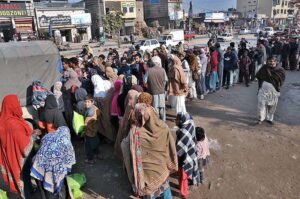
The social outcomes are even more damning, because this is where the moral bankruptcy of the settlement becomes impossible to hide. Pakistan’s Human Capital Index stands at 0.41, meaning a child born today will achieve only 41 percent of the productivity she could have reached with full health and education. Around 40 percent of children under five are stunted. The 2024-25 Household Integrated Economic Survey records that 28 percent of school-age children are out of school nationally, between 20 and 25 million children condemned to diminished lives. Pakistan finished last out of 148 countries on the World Economic Forum’s Global Gender Gap Index in 2025. Female labour-force participation sits at 22 percent, against more than 80 percent for men. Pakistan and Afghanistan remain the only two countries on earth that have not eradicated polio. Roughly 400,000 Pakistani children every year receive no routine immunisations at all.
This is not collateral damage. This is the bill.
And the bill is being paid in the sectors that were devolved with parliamentary self-congratulation in 2010: health, education, population planning, social welfare, women’s development, labour and skills. The theory was that proximity would improve performance, that provinces being closer to the citizen would govern better than a distant federation. The reality is that provinces have spent more, hired more, announced more and delivered little that is durable at scale. There have been isolated successes. But no province has built the institutional machinery that devolution was supposed to unleash. Provincial expenditure rises; service delivery stagnates. In Q1 FY25, provincial expenditures rose 33 percent year on year. Development spending rose 4 percent. The state is growing, but not in the places that help citizens live better lives.
Then there is the most revealing betrayal of all. Article 140A of the Constitution requires every province to establish local governments with devolved political, administrative and financial authority. All four provinces have violated that constitutional command, repeatedly and shamelessly, since 2010. Punjab dissolved its elected local bodies before the end of their term in 2019, an act the Supreme Court later declared unconstitutional. Sindh continues to run Karachi, a city of more than 20 million people, through a provincial bureaucracy that treats metropolitan government as a nuisance to be contained. Khyber Pakhtunkhwa has periodically empowered and then neutered local bodies. Balochistan has barely sustained meaningful local government at all.
This is the heart of the fraud. Power was taken from Islamabad, but it was never handed to citizens. It was intercepted by the provinces and locked there. Chief ministers who sermonise about federal overreach have no objection to strangling mayors, councils and districts inside their own domains. They understand exactly what genuine devolution would mean: a rival centre of legitimacy, money and patronage inside their borders. And so they kill it.
Pakistan has spent sixteen years constructing the worst of every available model. The federation is too weak to invest, too indebted to plan, too constrained to coordinate. The provinces are too captured to tax, too thin to deliver, too insecure to devolve further. Citizens are left with the consequences: stunted children, absent schools, low-skilled labour, excluded women, failing health systems, and a state that borrows to pay interest on yesterday’s failures.
This is not a federation in working order. It is a constitutional shell wrapped around a distributional arrangement that benefits everyone except the public.
What should happen now is obvious, and long overdue.
The National Finance Commission must be reopened, and revenue effort must matter far more than the token 5 percent it does now. A province that refuses to collect agricultural income tax at its own statutory rates should not keep receiving an untouched share of the divisible pool. The principle is already on the table. The National Fiscal Pact attached to the 2024 IMF Extended Fund Facility commits provinces to enhanced tax collection and a coordinated approach to fiscal responsibility. What remains is to harden that pact into constitutional architecture, rather than letting it expire with the programme. Transfers without responsibility are not federalism. They are fiscal indulgence.
Article 140A needs teeth. Not speeches, not pledges, not another cycle of ornamental local elections. India’s 73rd and 74th Constitutional Amendments did the work Pakistan has refused to do. They specify minimum percentages of state revenue that must flow to local governments, and they create State Finance Commissions to enforce the formula. Pakistan should follow that model. A minimum provincial-to-local fiscal transfer must be written into the Constitution, enforceable by the Supreme Court rather than left to the whims of chief ministers who regard city governments as political threats.

Provinces should also bear a transparent share of federal debt servicing proportional to the transfers they receive. As long as the centre alone carries the debt while the provinces alone enjoy the transfers, the federation will continue to borrow while everyone pretends the consequences belong to someone else. The current provincial cash-surplus arrangement already admits the principle. It is time to formalise it openly.
The Council of Common Interests must be revived as a working institution rather than a ceremonial afterthought. Articles 153 and 154 already give the CCI authority over inter-provincial coordination on water, power, oil and gas and broader policy frameworks. What is missing is not law but seriousness: mandatory meetings, binding decisions, a professional secretariat and consequences for non-compliance. Without that, every major coordination failure, on water, power, energy, climate and internal migration, will continue to drift until it becomes a crisis.
Provincial right-sizing must follow federal right-sizing. Provinces have inherited mandates without building delivery systems, absorbed authority without building competence, and claimed ownership without accepting scrutiny. The next NFC award should tie transfers not simply to entitlement, but to demonstrable capacity and performance, with service-delivery audits against each province’s constitutional remit, published by the Auditor General and debated in the National Assembly.
The 18th Amendment was not wrong to address Pakistan’s federal imbalance. But it was sold as a cure and implemented as a carve-up. It settled the question of who gets what share, while evading the harder question of who delivers what outcome. Sixteen years later, the answer is visible in every classroom that does not exist, every child who cannot grow properly, every woman shut out of the labour market, every mayor reduced to ceremony, every budget swallowed by interest payments.
Pakistan does not need a debate between devolution and recentralisation. It needs a reckoning with the lie that devolution, by itself, is democratic success. A federation that cannot tax, cannot coordinate, cannot deliver and will not devolve below the province is not a federation in any meaningful sense. It is an evasion.
And the people paying for that evasion are the citizens in whose name it was all done.

Fazeel Asif
The author is a policy maker and expert is socio-economic development. He can be reached out at : [email protected].

