

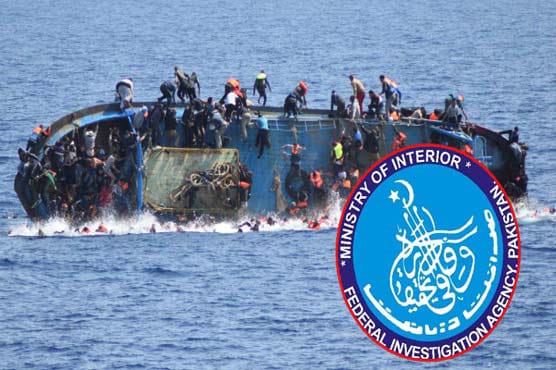
ISLAMABAD – The Federal Service Tribunal (FST) Islamabad has issued three separate but closely connected judgments that collectively overturn a large number of dismissals of Federal Investigation Agency (FIA) officials linked to the Greece boat tragedies of 2023 and 2024. In all three cases, the tribunal set aside the termination orders and directed reinstatement of the affected officers with full back benefits, holding that the disciplinary proceedings were legally defective,
based on insufficient evidence, and in several instances arbitrary and discriminatory. The cases arise from two major maritime disasters off the coast of Greece in 2023 and 2024, where hundreds of Pakistani nationals lost their lives while attempting to reach Europe through irregular migration routes involving Libya and the Mediterranean Sea. Following these incidents, FIA initiated large-scale departmental proceedings against immigration officials posted at various airports, including Karachi, Multan, Faisalabad, and other immigration stations. The officials were accused of negligence in clearing passengers who were later found to have been part of human smuggling networks. In the first judgment, which primarily dealt with FIA officials posted at Jinnah International Airport, Karachi, the tribunal examined allegations that immigration staff had cleared passengers who later became victims of the Greece boat tragedy.
The court found that all passengers had travelled on valid passports, visas, return tickets, and other required travel documents that were duly verified at the time of departure. It noted that no evidence had been produced to show that any document was forged, invalid, or improperly processed by the officials concerned. The tribunal further observed that FIA failed to identify any specific violation of immigration rules or Standard Operating Procedures attributable to the appellants. It held that immigration clearance was carried out in accordance with established systems, including airline verification mechanisms such as “OK to Board” processes, and that subsequent events occurring outside Pakistan could not legally be attributed to the officials who cleared the passengers. The judgment also criticized the inquiry process for failing to record witness statements, denying cross-examination, and relying on assumptions rather than evidence. It further noted discriminatory treatment, where similarly placed officers received minor penalties while others were dismissed without justification.
In the second judgment, the tribunal dealt with appeals arising from FIA immigration staff posted at Multan International Airport, including a Shift Incharge who was dismissed after being held responsible for clearing passengers later linked to the Greece tragedy. The record showed that an initial fact-finding inquiry had already concluded that there was no direct or indirect evidence of mala fide intent or criminal involvement by the immigration staff. It also acknowledged that passengers had travelled on valid documents processed under existing FIA Standing Orders, which required reliance on airline-issued authorization and valid travel documentation. Despite this, FIA ordered fresh inquiries that resulted in dismissal orders. The tribunal strongly criticized the escalation of punishment beyond the inquiry recommendations, noting that in some cases the Inquiry Officer had proposed lesser penalties such as reduction in rank, but the Director General FIA enhanced the punishment to dismissal without recording any reasoned justification. Interestingly the whole premise of the punishment saga revolves around a presumption that illegal immigrants of Pakistani origin were drowned but at the same no specific dead bodies were identified as such. Even the names of those reduced were put in the list of dead ones. Irony at its peak. The court found multiple procedural violations, including failure to examine witnesses, denial of cross-examination, and non-compliance with mandatory rules under the Civil Servants (Efficiency & Discipline) framework. It further held that repeated fact-finding inquiries without new evidence reflected a predetermined approach rather than a genuine fact-finding exercise.
In the third and most comprehensive judgment, the tribunal decided fourteen connected appeals involving FIA officials from multiple regions. These appellants were also accused of negligence in connection with the same Greece boat tragedies, where passengers cleared from Pakistan later became victims of illegal migration networks. The tribunal observed that earlier departmental inquiries themselves had acknowledged that immigration staff processed passengers in accordance with SOPs and that no evidence of corruption, collusion, or intentional wrongdoing had been established. It reiterated that clearance was based on valid travel documents and airline verification systems, and that immigration officers could not be held responsible for events that occurred after passengers had lawfully departed from Pakistan. The judgment identified serious defects in the inquiry process, including lack of proper evidence recording, absence of witness examination, and reliance on generalized conclusions. It also highlighted inconsistent disciplinary outcomes, where similarly placed officials were given minor penalties while others were dismissed for identical allegations. The tribunal held that such selective treatment violated the principle of equality and rendered the entire disciplinary process arbitrary. It emphasized that dismissal from service is the most severe form of punishment and cannot be imposed on the basis of suspicion, assumptions, or public pressure following tragic incidents, but must be supported by clear and reliable evidence of individual misconduct. Taken together, the three judgments represent a significant judicial rebuke of FIA’s handling of disciplinary actions related to the Greece boat tragedies.
The tribunal has effectively concluded that the agency’s actions were driven more by assumptions and administrative pressure than by concrete evidence or legally sustainable findings. It has reinforced that immigration officials performing routine duties cannot be held liable for subsequent criminal conduct of passengers abroad unless specific and proven misconduct is established at the time of clearance. The rulings are expected to have wide-ranging implications for FIA’s internal accountability system, particularly in how inquiries are conducted, how evidence is evaluated, and how disciplinary penalties are imposed in high-profile cases involving human smuggling and migration-related incidents.

