

ISLAMABAD – Recent developments affecting airspace in parts of the Gulf have once again highlighted the region’s strategic importance for global aviation.Even limited restrictions or precautionary measures in the area can have a significant impact on international flight operations, as the Gulf serves as a major aerial corridor connecting Europe, Asia, and Africa.
At the center of this aviation system is Hamad International Airport, a major global transit hub handling large volumes of international transfer passengers and cargo every day.The airport provides efficient connections between East and West, allowing airlines to link multiple continents through a single transit point.
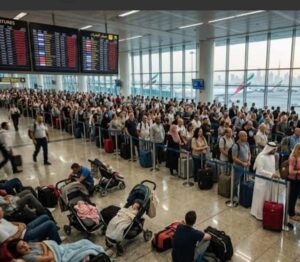
Recent security driven precautions in parts of the Gulf have led airlines to closely monitor regional airspace conditions.In some cases, aircraft have had to adopt alternative flight paths to avoid potentially sensitive zones. Such adjustments often increase travel distances, resulting in longer flight times and higher fuel consumption.Although modern navigation and air traffic management systems allow airlines to adapt relatively quickly, repeated diversions can affect scheduling efficiency and operational planning.
Key regional aviation hubs, including Dubai International Airport and King Khalid International Airport, have continued operating while implementing precautionary safety protocols to ensure uninterrupted flight services.The Gulf region handles a significant share of long-haul international flights. Therefore, any operational challenges affecting the region’s airspace can have broader implications for global aviation networks.

Industry observers suggest that prolonged disruptions could influence airline route planning, aircraft deployment strategies, and the selection of transit hubs.Airlines typically design their global schedules months in advance, considering fuel efficiency, flight time, and airspace accessibility.When uncertainty arises in key transit corridors, airlines may temporarily modify flight paths or reassess network planning to maintain operational stability.
Beyond passenger travel, the Gulf also plays a crucial role in global air cargo operations. Major airports in the region act as distribution centers linking manufacturing hubs in Asia with markets in Europe, Africa, and the Middle East. Cargo networks connected through Hamad International Airport and Dubai International Airport are particularly important for transporting time-sensitive goods such as electronics, pharmaceuticals, and perishable products.
Logistics specialists note that any long-term disruption to regional airspace could increase transportation costs and extend delivery times. In response to evolving regional security dynamics, aviation observers believe Gulf countries may continue strengthening coordination mechanisms to safeguard airspace stability. Potential initiatives being discussed include the creation of contingency air corridors during emergencies, improved information sharing among civil aviation authorities, and the expansion of advanced monitoring systems using satellite and radar technologies.Enhanced collaboration between aviation regulators and international airlines is also considered important to ensure timely operational updates and coordinated responses during rapidly changing conditions.
Despite periodic geopolitical tensions, the Gulf remains one of the most advanced and resilient aviation regions in the world.Its modern airports, capable airlines, and sophisticated air traffic management systems provide a strong foundation for maintaining global air connectivity.
For international aviation stakeholders, the evolving situation underscores the broader strategic significance of Gulf airspace in sustaining the movement of passengers and cargo across continents.As the aviation sector continues to adapt to shifting geopolitical realities, maintaining stability and cooperation within the Gulf’s airspace framework will remain essential for the smooth functioning of global air transport networks.

