

There is something oddly poetic about Islamabad. A city designed on clean lines, disciplined sectors, and a promise of order—constantly wrestling with the chaos of human ingenuity. For years, encroachments, illegal structures, and quiet violations have chipped away at that vision. And then, for a brief moment, it seemed like someone had decided to fight back.
Enter Mohsin Naqvi—the man of the hour, the unexpected custodian of Islamabad’s lost symmetry. Armed with bulldozers, notices, and what appeared to be an unusual commitment to enforcing the law, he began doing what many before him had avoided: clearing illegal constructions. Roads widened, green belts reclaimed, and long-standing encroachments—some of them brazenly obvious—began to disappear.
People applauded. Social media, usually cynical, found itself momentarily generous. “Finally,” they said, “someone is doing his job.” Islamabad, for once, seemed to be returning to the idea it was originally built upon—not just a capital, but a planned one.
But in Pakistan, every good story has a twist. And this one was no different.
The trouble began when the bulldozers, quite innocently, wandered too close to power.
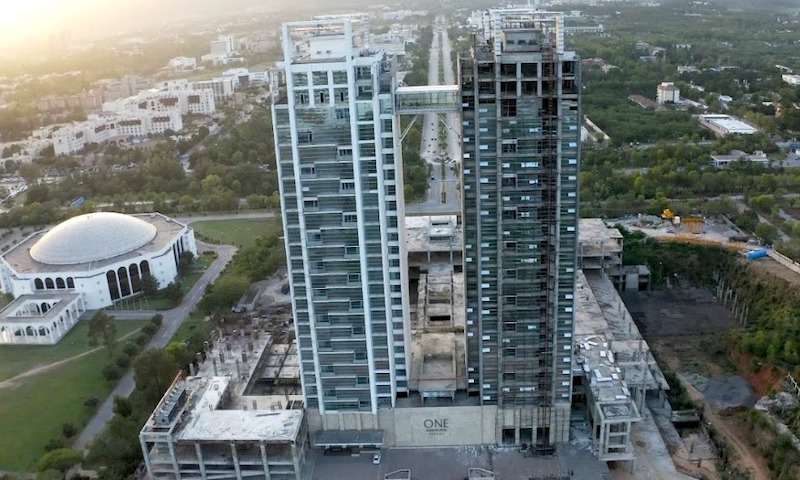
Among the many illegal structures standing tall in Islamabad were a couple of towers—monuments not just of concrete, but of influence. These weren’t your typical encroachments. These towers housed the elite: the well-connected, the well-placed, the untouchable. Their apartments weren’t just homes; they were investments, status symbols, and in some cases, insurance policies against inconvenience.
Now, here’s where things get interesting.
Acting on court orders—yes, the same sacred legal backing that had justified the demolition of smaller, less glamorous violations—Mohsin Naqvi and the CDA moved to vacate these towers. Legally, there was little ambiguity. The structures were deemed irregular. The law, in theory, was clear.
But law, in Pakistan, is often less about clarity and more about context.
Suddenly, the hero of yesterday became the villain of today.
The same voices that had praised Naqvi for “restoring Islamabad’s beauty” began to discover nuance. Concerns were raised. Questions emerged. Was this the right time? Could there be another solution? What about the residents? What about the investments? What about—most importantly—the inconvenience to those who are not used to being inconvenienced?
And just like that, the narrative shifted.
The Prime Minister stepped in. The CDA was asked to pause. Evictions were halted. Demolitions, once inevitable, became uncertain. The law, it seemed, had encountered something stronger than itself: discomfort at the top.
This is what elite capture looks like—not as a grand conspiracy, but as a subtle recalibration of priorities.
It is worth remembering that this is not Pakistan’s first brush with selective enforcement. When informal settlements—kachi abadis—are demolished, there is rarely a pause for reflection. Bulldozers do not hesitate. Families are displaced overnight, their belongings scattered, their lives disrupted. The justification is always the same: the law must take its course.
Similarly, when the Nasla Towers in Karachi were demolished on the orders of the Supreme Court, the residents—many of them middle-class families—had little recourse. Their protests, their pleas, their investments—none could stand against the finality of a court order. The law, in that instance, was swift, decisive, and unyielding.
But this time, something was different. This time, the occupants were not poor. They were not voiceless. They were not invisible. They were the elite. And the law, suddenly, developed a conscience.
One cannot help but admire the efficiency of this transformation. Within hours, the momentum shifted. What was once a straightforward legal exercise became a matter requiring “reconsideration.” What was once an enforcement drive became a “sensitive issue.”
Reports now suggest that Mohsin Naqvi himself has taken a step back, observing—quite sensibly—that if the state cannot enforce the law against the powerful, it loses the moral authority to enforce it against the powerless. It is a rare moment of honesty in a system that thrives on selective amnesia.
Because this is the real tragedy of elite capture: it does not just protect the privileged; it delegitimizes the entire system.
When the poor see their homes demolished while illegal mansions stand untouched, they do not just lose shelter—they lose faith. When the middle class watches their investments crumble while elite properties are shielded, they do not just lose money—they lose trust. And when the law bends, ever so slightly, for those at the top, it sends a message that echoes far beyond the capital: justice is not blind; it is simply selective.
Islamabad, in this story, is more than a city. It is a metaphor.
A place where rules exist, but their application depends on who you are. A place where enforcement is celebrated—until it becomes inconvenient. A place where beauty is restored, but only up to a point.
Mohsin Naqvi’s brief stint as Islamabad’s restorer-in-chief offers a valuable lesson. It shows that change is possible, but only within limits. It shows that the machinery of the state can function, but only until it encounters resistance from those who know how to operate it.
And perhaps most importantly, it shows that in Pakistan, the real battle is not against illegal structures—it is against the invisible architecture of privilege that sustains them.
Until that changes, Islamabad will continue to oscillate between order and chaos, between law and exception, between what is right and what is convenient.
And elite capture will remain, as always, at its best.

Zalmay Azad
The author is an Islamabad-based journalist and a regular contributor for NEWSMAN

